
D.C. Circuit Review – Reviewed: Another Mine Run Week
The D.C. Circuit issued four opinions last week. On the admin law side, it was another mine run week: significant to the parties, of course, but fairly standard applications of fairly settled admin law doctrines. (Outside of admin law, last week’s opinions had an international flair, with the court issuing opinions on the Foreign Sovereign Immunities Act and aiding and abetting liability under the Anti-Terrorism Act).
The first decision is Petro Star Inc. v. FERC, No. 23-1348. The case relates to a “decades-long dispute” among entities that ship oil via the Trans-Alaska Pipeline System (TAPS). Because higher quality and lower quality oil is commingled in the pipeline, shippers of lower quality oil pay into a “Quality Bank” and shippers of higher quality oil receive payments from the Bank. FERC regulates the Quality Bank formula, which is incorporated into the TAPS owners’ tariffs. As often happens in the D.C. Circuit, the court considered a consolidated set of cases where one shipper argued that FERC overvalued one component of the formula, another argued that FERC undervalued that component, and a third set (pipeline owners) objected to a finding of tariff violations related to how the formula was implemented. The D.C. Circuit, with Judge Rao writing, rejected the arbitrary-and-capricious claims of all of the petitioners. Perhaps the most noteworthy part of the opinion was the court’s clarification that its direct-review jurisdiction over FERC orders involving oil pipelines still rests on the Hobbs Act. (The court has oft exercised such direct-review jurisdiction after the Interstate Commerce Commission Termination Act, but without explaining its continuing jurisdiction until now.)
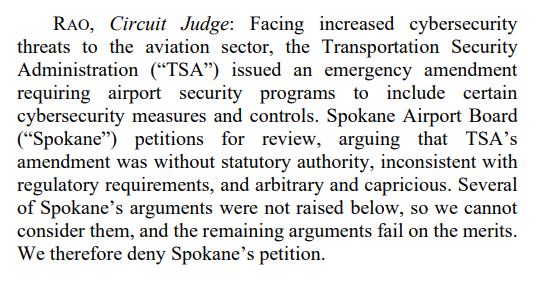
The second decision for the week is Spokane Airport Bd. v. TSA, No. 23-1155. It covers a host of issues, from statutory authority to arbitrary-and-capricious review to issue exhaustion. I cannot do better than the court’s opening summary: