Mirroring the Market: Passive Voting and Outcome Non-Neutrality
PDF DownloadPassively managed investment funds are exercising ever-increasing voting power in public corporate elections in firms with publicly traded shares. The growing control of corporate elections by investors who are supposed to be passive and uninvolved raises significant problems. To neutralize this outsized influence, mirror voting—the practice of voting passive shares in proportion to the instructions of active investors—has emerged as the leading legislative and regulatory response. Proponents argue that by mimicking the active market, passive funds can achieve strict neutrality, ensuring that corporate outcomes are dictated solely by engaged, informed investors.
This Article shows that the current regulatory consensus relies on a mathematically flawed heuristic. By uniformly mirroring only the ratio of submitted affirmative and negative instructions, current proposals merely match submitted votes while fundamentally altering the actual outcomes of corporate elections. By ignoring the shifting, dynamic denominators of state corporate law, uniform mirroring eviscerates the legal weight of active shareholder silence. Uniform mirroring inadvertently subsidizes corporate quorums and inflates approval ratios, converting active market apathy into affirmative support and artificially lowering the statutory thresholds required for both standard proposals and fundamental corporate changes. We propose a new approach, the implementation of Context-Dependent Mirroring, a framework that dynamically calibrates passive proxy submissions to the specific legal hurdles of each ballot item as the only way for passive investors to achieve the neutrality they promise to the investing public.
Finally, we show a fundamental conflict between the mechanical realities of modern proxy infrastructure and the achievement of true outcome neutrality. The submission of a proxy with a vote on any issue registers shares as present for a quorum that allows votes on every issue on the agenda of a meeting, meaning that universal participation by passive investors can validate contested meetings and change the outcome of corporate votes. We show that, in some cases, the only way for a passive fund truly to fulfill the goal of neutrality is to deliberately withhold its shares from the proxy system entirely. This conclusion reconsiders the fiduciary duty of investment advisers under the Investment Advisers Act of 1940, suggesting that when the act of voting itself becomes an intervention, the duty of care may actually require informed non-participation.
Introduction
A defining feature of modern corporate finance that has profound implications for corporate governance is the dramatic and apparently inexorable increase in equity ownership of public companies by passively managed index funds. Today, the “Big Three” asset managers—BlackRock, Vanguard, and State Street—collectively hold voting power across the vast majority of publicly traded U.S. corporations that often is outcome determinative in critical corporate elections.1 This poses an acute dilemma for governance because these institutions are, by design, fundamentally passive and indifferent to the active, firm-specific information necessary to optimally exercise their voting rights.2 As passive index funds continue to gather market share, regulators and scholars have grown increasingly concerned about a growing vacuum in the governance of America’s largest and most important companies due to the massive blocks of passive stock holdings. This vacuum has led to a secular reduction in market-driven accountability and a crisis in corporate governance.3
Developing a response to this problem has therefore become a central focus of federal regulatory policy. In December 2025, President Trump signed Executive Order 14366, titled Protecting American Investors from Foreign-Owned and Politically-Motivated Proxy Advisors.4 The Order explicitly directs the Securities and Exchange Commission (SEC) to reassess the mechanical voting practices of institutional advisers, specifically questioning whether the routine following of third-party proxy advisors violates the fiduciary duty of care.5 This “seismic shift,” as described by SEC Division of Investment Management Director Brian Daly in early 2026, has put voting by passive funds at the center of the regulatory agenda.6
Seeking to mitigate the vast concentration of voting power in passive index funds, many academics and policymakers have landed on a simple solution: “proportional” mirror voting.7 Featured prominently in both the 2026 Daly remarks and in the legislative framework of the INvestor Democracy is EXpected (INDEX) Act,8 mirror voting is proposed as a mechanism through which index funds can fulfill their fiduciary duties to their investors by simply voting their shares in a way that matches (or “mirrors”) the ratio of votes cast by the active market.9 The goal is to achieve neutrality—preventing passive investors from determining the outcomes of corporate elections10 and thereby insulating passive investors from claims of improper interference. The SEC is currently exploring rules that would treat such mechanical mirroring as a de facto fulfillment of the principle of neutrality between incumbent management and outside activist investors reflected in provisions like Section 13(d) of the Exchange Act.11
We question whether proportional mirror voting fulfills its goal of achieving neutrality. At first glance, it may seem that this proportional mirroring achieves neutrality and has the added benefit of successfully overcoming the problem of retail investors’ rational apathy, allowing corporations to attain the voting thresholds necessary to satisfy statutory and contractual quorum requirements. The problem is that crude proportional mirror voting does not achieve its stated goal of producing outcome neutrality in corporate elections.
Thus, while we support mirror voting in principle, current approaches to mirror voting rely on a mathematically flawed assumption that ignores state corporate law. As we demonstrate below, the mechanics of mirror voting must be adjusted in fundamental ways. Current “proportional” mirror voting proposals, by focusing exclusively on the simple voting percentages among the votes cast by participating active investors, can skew election results. This happens because they treat the votes-cast numerator as the only legally relevant variable. By ignoring the distinct legal weight of the denominator of corporate law, mirror voting becomes an interventionist subsidy that fundamentally alters election outcomes.
A simple example illustrates our point. Imagine a company with 100 outstanding shares, evenly divided between 50 active investors and a 50-share passive index fund. Suppose that for a contested resolution, only 1 active shareholder casts a ballot, voting “For,” while the remaining 49 active shares are absent. Under a uniform mirroring policy, the passive investor observes a 100% approval ratio among votes cast and so submits its 50 shares as “For.” When the corporate secretary tallies the attendance, 51 shares are legally present, artificially establishing a quorum. The matter passes with an absolute majority despite receiving the affirmative support of only a single active shareholder, without any other investor having considered the resolution. It is in this way that the uniform mirroring solution currently being considered acts as an interventionist ratchet that can both validate meetings that would otherwise fail quorum requirements and systematically lower the threshold for proposals to pass.
This Article makes three primary contributions to the literature on corporate governance and passive voting. First, we demonstrate analytically that the current legislative and regulatory conception of uniform mirror voting is mathematically flawed. By mapping the shifting denominators of state corporate law, we quantify how uniform proxy participation creates a “quorum subsidy” and a “denominator trap.” We prove that uniform mirroring fundamentally alters the ex-ante baseline of corporate elections by converting active market apathy into affirmative support, thereby artificially lowering the statutory thresholds required for corporate changes.
Second, we introduce the framework of Context-Dependent Mirroring. Rather than relying on a mathematically incomplete, one-size-fits-all approach, we provide precise quantitative algorithms that allow passive funds to dynamically calibrate their proxy submissions to the specific statutory hurdles of a multi-item ballot. We demonstrate that by mathematically internalizing active market silence, index funds can participate in the proxy process without overriding the active market’s vote.
Finally, we show a fundamental conflict between the mechanical realities of modern proxy infrastructure and the achievement of true outcome neutrality. As we describe, the fiduciary duty of investment advisers has traditionally been interpreted by regulators as a mandate for universal proxy participation—an “always-vote” paradigm. However, because the mere act of submitting a proxy legally registers a share block as present, outcome neutrality and universal participation can be mutually exclusive. We demonstrate that in some cases, the only way for a passive fund to fulfill its fiduciary promise of neutrality is to engage in informed non-participation by deliberately withholding its shares from the proxy system entirely.
This Article proceeds in six parts. In Part I, we establish outcome neutrality as the necessary baseline for evaluating passive voting strategies. In Part II, we map the typology of corporate voting hurdles under state law, demonstrating how the legal weight of shareholder abstention and absence shifts depending on the specific statutory denominator. In Part III, we show exactly how uniform mirroring alters outcomes in corporate elections and precisely quantify the degree to which uniform mirroring lowers the approval threshold for fundamental transformations. In Part IV, we detail the mechanical frictions of quorum and the proxy infrastructure and show how mirror voting can artificially validate corporate meetings. In Part V, we develop Context-Dependent Mirroring, showing how passive investors can vote to truly remain outcome neutral. Finally in Part VI, we address the fundamental conflict between the duty to vote and the goal of outcome neutrality, arguing that fulfilling the fiduciary duty of care occasionally requires deliberately withholding shares. The Appendix provides precise mathematical formulae and sample contract language for the easy application of true outcome neutrality.
I. Towards Outcome Neutrality in Voting
The concentration of equity ownership in the hands of institutional investment intermediaries, primarily the asset managers offering passively managed index funds, including BlackRock, Vanguard, and State Street Global Advisors, has fundamentally transformed the landscape of modern corporate governance.12 While this historic shift from active stock-picking to broad-based passive indexing provides immense cost-efficiency and diversification benefits for retail investors, it simultaneously creates a governance vacuum at the heart of public markets.13 Because passive funds are designed to track the performance of a market index rather than to outperform it, they inherently lack the financial incentive to generate firm-specific information or actively monitor the individual companies within their sprawling portfolios.14 Furthermore, these institutional intermediaries face an acute collective action problem: any costly intervention to improve a specific portfolio company’s governance will equally benefit all competing funds tracking the same index, effectively penalizing active managers for their stewardship expenditures.15 As a result, passive funds are structurally designed to be entirely uninvolved in governance, yet their sheer size dictates that they frequently exercise determinative voting power to unilaterally swing the outcomes of contested corporate elections, mergers, and fundamental governance changes.16
Although these massive institutional intermediaries lack both the inclination and the incentives necessary to engage appropriately in corporate voting, their involvement in corporate elections, especially when that involvement is outcome determinative, is fundamentally inconsistent with their promises to regulators and investors that they will remain passive and neutral. If the entities holding the decisive swing votes are structurally uninformed and primarily motivated by asset accumulation rather than firm-specific value maximization, the market for corporate influence becomes deeply distorted. Concerns about voting by passive index fund investors have accordingly led scholars and regulators increasingly to recognize that their outsized influence threatens the legitimacy of corporate governance.17
To resolve this tension, we propose that achieving the theoretical baseline of “outcome neutrality” be used as the guiding metric for regulating passive voting. At its core, outcome neutrality demands that the introduction of passive investors into a company’s capital structure not result in election outcomes being any different than they would be in the absence of such investors. Specifically, when faced with a vote, outcome neutrality begins with two specific questions: (a) “if the population of active investors constituted the entire investor population, would the necessary quorum to hold a vote have been achieved?” and (b) “if so, what would the outcome of that election have been?” A fund practicing outcome neutrality, then, should cast its votes in a manner that ensures that the final outcome is the same as it would have been if the active investor population constituted the entire voting population.
This policy goal of outcome neutrality is firmly rooted in the fiduciary integrity of the investment advisers themselves. That is, if a passive fund’s mechanical voting alters a fundamental corporate outcome, the fund has engaged in a discretionary act that arbitrarily picks winners and losers, potentially violating its fiduciary duty of care under the Investment Advisers Act of 1940.18 The possibility that such interference might be inadvertent or even unwilling does not change the fact that it is inappropriate and improper and possibly illegal. Importantly, our proposed policy goal of prioritizing outcome neutrality should preserve the essential mechanisms utilized by active, informed investors—such as quorum boycotts and strategic abstentions—to ensure that corporate affairs remain governed exclusively by those market participants who actually expend the resources to evaluate them.
In an attempt to neutralize the collateral consequences of passive index fund voting and mitigate the concentration of institutional voting power, recent legislative efforts like the INDEX Act have advanced a simple conception of uniform mirror voting.19 Under the proposed uniform mirroring regime, passive funds would be instructed to vote their massive share blocks in strict proportion to the “votes submitted” by the active market, thereby, at least theoretically, stepping aside to let the active investors dictate the result.20
Similarly, current mirror voting initiatives call for shares to be voted by passive index fund investors in the same proportion as the votes cast by active investors. For example, Vanguard’s mirror voting policy calls for votes to be cast by Vanguard funds “in approximately the same proportions as votes cast for the meeting by other shareholders of the security.”21 State Street’s version of mirror voting stipulates that “the funds’ trustees vote in a manner proportionately reflecting the voting decisions of other shareholders in the companies it holds.”22
At first glance, it may seem that the uniform mirroring proposal in the INDEX Act and the existing uniform mirroring policies of the investment advisers successfully internalize the externalities of passive ownership. By dictating that passive funds simply match the active market’s affirmative and negative proxy signals, these heuristics appear to defer to engaged voters. This raises the question: does this “instruction neutrality” equate to outcome neutrality? In short, no.
In corporate law, the legal effect of an active shareholder’s decision— including the sometimes strategic choice to decline to vote—varies depending on the specific standard governing the ballot item. The standard is determined by state law, which often is supplemented by provisions in contracts and corporate charters and bylaws. 23 Each of these voting regimes requires that the calculation of the percentage of votes attained in an election be made with denominators that vary depending on the particular issue being considered at the election. These “dynamic denominators” range from a simple majority of votes cast to an absolute majority of all outstanding shares, which makes the denominator equal to the number of outstanding shares, regardless of the number of votes cast.24 In sharp contrast with our approach, uniform mirroring entirely ignores these heterogeneous ex ante standards, focusing exclusively on the ratio of the votes-cast numerator and ignoring the distinct legal weight of the eligible-to-vote denominator. Utilization of this over-simplified mechanical heuristic nullifies the collateral consequences of active abstentions. As we describe below, in the context of elections where this denominator has import, a shareholder’s silence is a substantive, legally recognized barrier to corporate action that uniform mirroring mathematically erases.
Furthermore, this uniform heuristic fundamentally distorts the threshold condition for corporate voting to occur in the first place: the requirement that a quorum be attained in order for an election to be held. Before the outcome of any particular resolution can be determined, a meeting must legally convene.25 Active investors may utilize strategic absences to starve a contested meeting of its required quorum. In other cases, apathetic investors act as a structural guardrail against fundamental changes. A uniform mirroring policy that forces passive index funds to mechanically enter proxy instructions artificially subsidizes these quorums. By guaranteeing a legally valid meeting regardless of active market participation, uniform mirroring overrides the informed market’s tactical decision to decline to vote.
Ultimately, these two mechanical defects—the denominator trap and the quorum subsidy—demonstrate why instruction neutrality fails as a proxy for outcome neutrality. Rather than serving as a neutral safe harbor by which passive investors can deliver on their promise of neutrality, uniform proportional mirror voting operates as an interventionist ratchet that structurally lowers the threshold for proposals to pass. The following sections will quantify these distortions and propose a context-dependent framework to restore true passive neutrality.
II. The Typology of Corporate Voting Hurdles
To evaluate the structural soundness of any passive voting strategy, one must examine the precise mechanics of corporate voting. Current mirroring proposals mandate that passive funds vote in proportion to the active instructions received, ignoring the impact of non-votes. This heuristic implicitly treats all corporate votes as mathematically identical, functioning simply as a binary measurement of affirmative versus negative preference among participating shareholders. State corporate law, however, contemplates a more nuanced, two-stage procedural reality.
Before the outcome of any particular voting issue can be determined, the meeting at which the votes are cast must be legally convened. Under the Delaware General Corporation Law (DGCL), as in other jurisdictions, this requires achieving a meeting-wide quorum—which typically means that a majority of the shares entitled to vote must be “present” at the meeting either in person or by proxy.26 Significantly, a quorum is not established on an item-by-item basis. Once a shareholder submits a proxy instruction for any matter on the ballot, their shares are counted as present for the duration of the entire meeting.27 Once this initial quorum gate is cleared, the legal and mathematical weight of an active shareholder’s decision to withhold participation or explicitly abstain shifts dramatically depending on the statutory hurdle assigned to the specific resolution. Corporate charters and bylaws may also shift voting and quorum standards.28 Using the DGCL as the primary framework, we categorize corporate approval hurdles into a three-part typology based on their dynamically shifting denominators.
A. The “Votes-Cast” Standard
The simplest voting structure is the basic “Votes-Cast” standard. Under this framework, the legal denominator shrinks to include only those shares that are affirmatively cast with a formal “For” or “Against” instruction.29 This standard generally governs routine or advisory matters, such as precatory say-on-pay resolutions, and has also been adopted in some corporate bylaws to govern uncontested director elections.30 The default statutory standard for director elections—plurality voting—operates on the same mathematical principle, inherently ignoring “withhold” signals and non-participants.31
Under a Votes-Cast rule, shareholder absence and explicit abstentions are rendered legally irrelevant to the final calculation. Because these non-votes are excluded entirely, the decision of an active shareholder to stay home or formally abstain simply shrinks the denominator, proportionately inflating the relative weight of the remaining active voters.32 Within this specific, isolated context, uniform proportional mirroring is unproblematic. Because the legal denominator dynamically adjusts to match the participating numerator, an index fund that mirrors the ratio of “votes submitted” seamlessly replicates the outcome that would have occurred in its absence.
B. The “Present-Majority” Standard
The “Present-Majority” standard is the statutory default rule for most substantive corporate actions and governs general corporate business, including the ratification of independent auditors, the approval of executive equity compensation plans, and most binding shareholder proposals.33 Under this framework, once a meeting-wide quorum is established, a resolution under consideration faces an approval gate requiring the affirmative vote of the majority of shares present in person or represented by proxy at the meeting and entitled to vote on the subject matter.
This structure fundamentally alters the legal significance of the denominator by drawing a sharp distinction between total absence and formal abstention. When a matter is being voted on, the denominator in the voting equation consists of all shares physically or proxy-present at the meeting, even if these shares choose not to vote on a particular resolution. Consequently, an active shareholder who is present at the meeting either physically or via proxy, but abstains from voting on a particular issue, effectively casts a “No” vote, as their shares inflate the denominator without contributing to the affirmative numerator in the same way as a “No” vote.34 Conversely, an active shareholder who simply stays home and declines to be present either physically or by proxy, completely removes their shares from this item-specific denominator, which is the same thing that happens under a Votes-Cast standard.35
C. The “Absolute-Outstanding” Standard
The third standard, “Absolute-Outstanding,” requires that an agenda item receive approval by a majority of the outstanding shares, regardless of whether the shares are voted. It is the most stringent and the most significant, governing the most important decisions made by shareholders, including fundamental corporate changes such as mergers, consolidations, and significant amendments to the corporate charter.36 For these decisions, state law imposes a strict mathematical hurdle: to pass, a vote must attain the assent of an absolute majority of all outstanding shares. For instance, DGCL § 251 requires a merger agreement to be adopted by “a majority of the outstanding stock of the corporation entitled to vote thereon.”37 Thus, abstentions, absences, and broker non-votes are the equivalent of “No” votes.
As such, in an Absolute-Outstanding vote, the denominator is rigid and uncompromising. It consists of the entire universe of issued, voting-eligible equity regardless of how many shares are counted as present at a particular meeting. Because the numerator must exceed 50% of all shares entitled to vote on a matter in order to succeed, any share that fails actually to affirmatively vote “For” the resolution operates functionally as a “No” vote regardless of whether or not it is at the meeting in person or by proxy. In this context, the legal distinction between actively voting against management, formally abstaining, or simply ignoring the proxy materials collapses. Apathy, absence, and active opposition exert the exact same downward pressure on the resolution’s chance of passage. This standard is therefore specifically designed to preserve a corporation’s status-quo governance structure and organizational form unless a definite majority of the company’s stock affirmatively approve the change.
By mandating that passive funds calculate their mirrored instructions based solely on the ratio of “votes submitted,” current proposals incorrectly treat votes cast subject to the Absolute-Outstanding standard as though they had been cast under the entirely distinct Votes-Cast standard, which, as described above, only requires agenda items to receive a majority of the votes actually cast in order to pass. This approach to mirror voting ignores the differences among these various voting standards embedded in the law, and in doing so undermines the goal of requiring certain absolute thresholds of participation and voting assent be achieved before changes in corporate policy occur. We refer to this problem as the denominator trap.38
III. Quantifying the Denominator Trap
To better understand the differences in voting thresholds described in Part II, we must observe how a static set of shareholder preferences interacts with the shifting denominators of corporate voting. Consider a hypothetical corporation with exactly 200 outstanding voting shares. Assume 100 shares are held by a passive index fund and 100 shares are held by active investors. We assume a standard 50% quorum threshold.
A passive voting strategy is only truly neutral if it leaves the distinct active-only outcomes unchanged. Under a uniform mirroring policy, such as the safe harbor proposed in the INDEX Act, a passive fund calculates its proxy allocation based exclusively on the submitted affirmative and negative instructions. When the distinct corporate voting hurdles are applied to this newly mirrored ecosystem, the facade of outcome neutrality completely fractures.
A. The Present-Majority Trap
Consider a highly contested binding proposal governed by the Present-Majority standard. The active market casts 39 shares “For,” 36 shares “Against,” and 5 shares explicitly “Abstain.” The remaining 20 shares are absent retail shares, whose proxies are registered as “Absent.”39
To apply the outcome neutrality principle, one must first establish the active-only baseline, temporarily ignoring the 100 passive shares. The meeting clears the 50-share quorum gate (that is, 50% of the 100 active shares) with 80 shares present.40 For the substantive item under the Present-Majority standard, the legal denominator is the 80 present shares. Because the 5 explicit abstentions inflate the required threshold without contributing to the affirmative numerator, the 39 affirmative votes represent only 48.75% support (39 out of 80). The proposal fails.
Now, we reintroduce the 100 passive shares into the equation to observe how a uniform mirroring policy disrupts this baseline. When the passive index fund applies a uniform mirroring policy, it only looks at the affirmatively and negatively cast votes (39 “For” and 36 “Against”), calculating a 52% approval ratio. It then applies this ratio to its own 100-share block, generating proxy instructions for 52 “For” votes and 48 “Against” votes, while entirely ignoring the 25 abstentions and absences among the active shareholding population.
The total vote submitted to the corporate secretary is therefore 91 “For” (39 active + 52 passive) out of 180 present shares. The affirmative tally jumps to 50.56%, causing the proposal to pass. By mathematically removing the active abstentions from its proxy submission, the passive fund explicitly violates outcome neutrality and enables a measure to pass that would have failed if the votes and non-votes of the active shareholders were accurately reflected.
Voting Standard | Active-Only Baseline (100 Shares) | Uniform Mirroring (200 Shares) | Neutrality Preserved? |
Present-Majority (e.g., Binding Proposals) | FAIL 39 For 36 Against 5 Abstain | PASS 91 For 84 Against 5 Abstain | NO. |
80 shares present (20 absent)
39 For / 80 present (48.75%) | 180 shares present (20 absent)
91 For / 180 present (50.56%) |
B. The Absolute-Outstanding Trap
This mathematical distortion under the Absolute-Outstanding standard, which governs fundamental changes such as mergers, is even more acute. Assume the same 20 absent shares, but the active market signals stronger support: 45 shares vote “For,” 30 vote “Against,” and 5 “Abstain.”
In the active-only baseline, quorum is established with 80 shares present. For the substantive item under the Absolute-Outstanding standard, the legal denominator is all 100 active shares. Given only 45 affirmative votes, the proposal fails.
However, under uniform mirroring, the passive fund calculates a 60% support ratio based solely on the cast votes (45 out of 75). It submits proxy instructions for 60 “For” votes and 40 “Against” votes. When added to the active tally, the total affirmative vote reaches 105 out of the 200 total outstanding shares. The approval rate inflates to 52.5%. By completely ignoring the active market’s apathy, the uniform mirroring heuristic functionally converts skepticism and strategic refusal to participate into affirmative support, overriding the strict statutory barriers intended to protect the status quo.
Voting Standard | Active-Only Baseline (100 Shares) | Uniform Mirroring (200 Shares) | Neutrality Preserved? |
Absolute-Outstanding (e.g., Mergers) | FAIL 45 For 30 Against 5 Abstain | PASS 105 For 70 Against 5 Abstain | NO. |
80 shares present (20 absent)
45 For / 100 active (45.0%) | 180 shares present (20 absent)
105 For / 200 total (52.5%) |
We emphasize that expanding the uniform mirroring heuristic to include formal abstentions does not cure the denominator trap. As reflected in this example, if the passive fund attempts to achieve instruction neutrality by mirroring the ratio of all participating active shares (45 “For,” 30 “Against,” and 5 “Abstain”), it calculates a 56.25% affirmative ratio (45 out of 80). Applying this ratio to its own 100-share block generates 56.25 “For” proxy instructions. When added to the active tally, the total affirmative vote reaches 101.25 out of the 200 total outstanding shares, yielding an approval rate of 50.625%. The resolution still passes, violating outcome neutrality. Because the Absolute-Outstanding denominator is statically fixed to all issued equity, the passive fund’s failure to also mirror the 20 active absences artificially inflates the relative weight of the participating “For” votes, clearly violating outcome neutrality.
C. Quantifying the Subsidy
Corporate voting is designed to ensure that fundamental transformations, such as mergers, achieve strict statutory baselines in order to prevent changes from being made to a company without broad stockholder approval.41 The Absolute-Outstanding standard requires the affirmative approval of a majority of all issued equity, meaning shareholder absence functions substantively as a negative vote. This reflects a policy choice to require broad support for fundamental corporate changes. Uniform mirror voting undermines this policy goal by voting passive shares based solely on the subset of active investors who participate and ignoring non-votes. In this way, uniform mirroring effectively and unjustifiably rewrites the statutory requirements of state corporate law in ways that have not been analyzed previously.
To further illustrate our concerns, in this section we reconstruct the effective statutory hurdle to quantify the exact subsidy granted to participating active investors through a uniform mirroring policy.
Let N represent the total outstanding shares of the corporation, divided between total active shares, A, and passive shares, P. Because passive funds mechanically utilize proxy infrastructure to submit instructions for their entire holdings, their participation rate is structurally fixed at 100%. Consequently, any unvoted, absent, or broker non-vote shares within the firm’s capital structure originate entirely from the active market. Let H represent the statutory hurdle—typically 50% of all outstanding shares.
To begin with, we must establish the mathematically neutral baseline. True outcome neutrality asks: “if the active market constituted the entire market, what would the outcome be?” Therefore, the neutral baseline approval rate from within the active market, which we denote as T, is simply equal to the statutory hurdle itself:
T = H
That is, if the statutory hurdle is 50%, the active market should need exactly 50% of its own shares, 50% × A, to support the measure for it to pass.
Uniform mirroring fundamentally alters this equation. Let Af denote the active shares that affirmatively vote “For,” and let Ac denote the total active shares that actually cast a ballot.
Under a uniform mirroring policy, the passive fund calculates its proxy submission in two steps. First, it isolates the participating active market to determine the instruction ratio. This ratio of affirmative support is simply the active “For” votes divided by the participating active shares:
Instruction Ratio = AfAc
Next, the passive fund calculates its actual affirmative vote, Pf, by scaling its entire block of passive shares, P, by this active instruction ratio:
Pf = P × AfAc,
and so, the total affirmative vote is given by:
Af + Pf = Af + PAfAc = Af(1 + PAc).
To pass a resolution governed by the Absolute-Outstanding standard, this total affirmative vote must meet or exceed the statutory hurdle, H × N. We set the total affirmative votes equal to this threshold:
Af(1 + PAc) = H × N.
Isolating Af yields the raw number of shares from the active market that must affirmatively vote “For” in order for the resolution to pass:
Af = (H × N) AcAc + P.
However, to directly compare this requirement to our neutral baseline, T, we must evaluate these required votes as a fraction of the total active market, A. Dividing both sides by A, yields the naïve threshold equation:
Tnaive = AfA = H NA AcAc + P.
This naïve threshold dictates the effective approval rate the active market must achieve from within its own ranks to pass a fundamental transformation when the passive market is employing a uniform mirroring policy.
To understand the effect of a uniform mirroring policy on the threshold to pass an item under an Absolute-Outstanding standard, consider a 200-share firm, N = 200, with shares evenly split between active and passive investors, A = P = 100. Assume a standard majority hurdle, H = 0.5.
If every active shareholder participates, 𝐴c = 100, then the equation yields 𝑇𝑛𝑎𝑖𝑣𝑒 = 𝑇 = 50%. The neutral baseline is perfectly preserved because there is no active absence for the fund to ignore.
However, if 10% of the total outstanding equity is absent, then the participating active shares drops to 𝐴𝑐 = 80. Plugging this into the naïve threshold equation yields a threshold of just 44.4%. That is, only 44.4% of the active market needs to vote in the affirmative on a fundamental transaction for it to pass under a uniform mirroring policy.
If instead the passive fund were to hold 60% of the firm (𝐴 = 80 and 𝑃 = 120, with 𝑁 = 200) and 20% of the total equity is absent (𝐴c = 40), then the threshold would collapse to 31.25%, meaning that a fundamental transformation could pass with less than one third support of the entire active market.
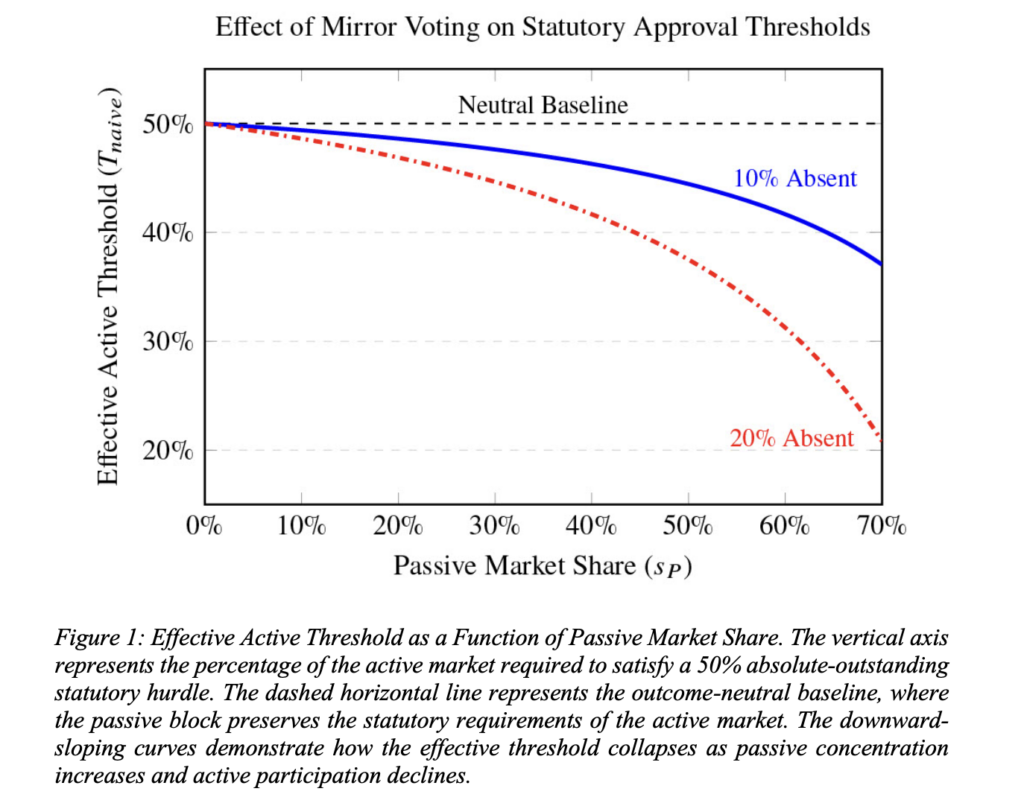
Figure 1 plots the effective active threshold as a function of the passive market share when the passive market employs a uniform mirroring policy. The horizontal dashed line at 50% is the ideal of outcome neutrality when the threshold for a fundamental transformation is at the standard 50%. If outcome neutrality were preserved, it would take 50% of the active market supporting an item for it to pass. The solid blue and dashed red lines show the effective active threshold when either 10% or 20% of shares are absent. Because the passive fund mirrors the votes of the active block, but not the absence of the active block, uniform mirroring lowers the threshold for fundamental transformations of the firm.
Importantly, this illustrates that uniform mirroring is not outcome-neutral but instead transforms the structural protections of corporate law. Uniform mirroring converts active market absence into affirmative support. Ultimately, by inflating the relative voting power of a participating minority, uniform mirroring replaces a rigid statutory barrier with a dynamic, pro-change, disruptive threshold.
IV. The Quorum Subsidy
In light of the clear mathematical divergence illustrated in Part III, one might wonder why passive funds do not simply adjust their behavior to mirror the active market’s apathy. In theory, if 20% of the active market ignores a proxy ballot, the passive fund could achieve outcome neutrality simply by withholding the votes of 20% of its own shares. That is, if the passive fund perfectly mirrors the active market—including abstentions and absences—then outcome neutrality should be assured.
In practice, however, this apparently simple fix collides with the mechanics of the modern proxy infrastructure and the fiduciary frameworks governing institutional advisers. The majority of institutional voting in the United States is intermediated by a highly centralized proxy plumbing system that is dominated primarily by Broadridge Financial Solutions.42 This infrastructure is designed to maximize efficiency, reliability, and shareholder participation. It operates almost entirely on the processing of affirmative voting instruction forms.43 The system is built to aggregate commands—“For,” “Against,” or “Abstain”—and transmit them to the corporate secretary to ensure meetings are legally validated and votes are definitively tallied.
Specifically, the structural distortion of uniform mirroring fundamentally alters the prerequisite of corporate voting: the meeting-wide quorum. The following example illustrates the mechanics of the quorum validation trap.
Returning to the hypothetical firm with 200 outstanding shares evenly divided between active and passive investors, requiring a 100-share quorum, consider what happens when a stockholders’ meeting simply fails to attract enough active participation to legally convene, whether due to shareholder apathy, lack of controversial ballot items, or a coordinated quorum boycott. Assume that the active investors vote 24 “For,” 6 “Against,” and 5 “Abstain,” while the remaining 65 active shares are completely absent (discarding their proxies entirely, with no routine items to trigger broker non-votes).44
In an active-only baseline, this lack of engagement has a definitive legal consequence. Only 35 active shares are present. Because this falls short of the 50-share quorum threshold, the meeting cannot legally occur, and the resolution is blocked by the quorum gate. Corporate law treats the active market’s collective silence as a structural veto.
However, the introduction of a uniform mirroring policy instantly overrides this outcome. The passive fund’s algorithmic heuristic only looks at the submitted instructions (24 “For” and 6 “Against”) and identifies an 80% approval ratio. To mirror this ratio, the fund formally submits its 100 proxies, casting 80 “For” and 20 “Against.”
The very act of utilizing the proxy machinery legally registers the passive shares as present. When the corporate secretary tallies the attendance, the 35 active shares are joined by the 100 passive shares, achieving the necessary quorum for all items on the agenda for the meeting. With the quorum established, the 104 total “For” votes easily clear the approval hurdle. This dynamic provides a structural “quorum subsidy” that guarantees that management can conduct a legally valid meeting, permanently neutralizing the legal weight of shareholder apathy and artificially breathing life into a mandate that the active market ignored.45
Voting Standard | Active-Only Baseline (100 Shares) | Uniform Mirroring (200 Shares) | Neutrality Preserved? |
Any | FAIL (No quorum) 24 For 6 Against 5 Abstain | PASS 104 For 26 Against 5 Abstain | NO. |
35 shares present
35 present / 100 active (35%) (Meeting blocked) | 135 shares present
104 For / 200 total (52%) (Meeting proceeds) |
V. Context-Dependent Mirroring
True outcome neutrality cannot be achieved if passive funds rely on a single, uniform heuristic when they engage in mirror voting. Because the legal denominator shifts depending on the statutory context and the presence of a quorum, the passive fund’s proxy formula must dynamically shift with it if neutrality is to be attained. We term the framework of shifting the denominator by mirroring the voting participation patterns of all shares and not just shares that actually vote “Context-Dependent Mirroring.” Under this approach, the passive fund does not blindly map its shares to the ratio of submitted instructions. Instead, it allocates its shares in order to achieve the outcome that would be achieved both by voting—and by not voting—just as the active shareholding population chooses to vote or not to vote.
To begin with, we assume in this section that the passive fund utilizes the proxy machinery and votes all of its shares. Whenever the active market establishes a quorum on its own, the passive fund can allocate its shares dynamically to successfully achieve outcome neutrality. As we will demonstrate in Part VI, if the active market fails to achieve quorum—restricting attention to the active market—then there are cases where outcome neutrality can only be preserved by withholding shares entirely. The following subsections illustrate the mechanics of Context-Dependent Mirroring and demonstrate how it resolves most of the structural distortions of uniform mirroring.
A. Solving the Present-Majority Trap
We return now to the binding proposal governed by the Present-Majority standard introduced in Section III.A, where the active market cast 39 shares “For,” 36 shares “Against,” and 5 “Abstain,” with 20 absences. In the active-only baseline, the proposal failed with 48.75% support (39 out of 80 present shares). Uniform mirroring artificially inflated this to 50.56%, causing it to erroneously pass.
Context-Dependent Mirroring cures this distortion by recognizing that the legally relevant denominator is the 80 present active shares. The passive fund maps its 100 shares strictly to this universe by mirroring the abstentions of the active investors. The fund does this by calculating its vote allocation by dividing the active instructions by the 80 present shares: it casts 48.75 “For” (39/80), 45 “Against” (36/80), and 6.25 explicitly “Abstain” (5/80).
When added to the active tally, the total affirmative vote becomes 87.75 out of 180 present shares. The final approval rate is 48.75%. The passive fund has successfully participated in the proxy system without altering the outcome that would have been achieved by the votes of the active shareholder population.
Voting Standard | Active-Only Baseline (100 Shares) | Uniform Mirroring (200 Shares) | Context-Dependent Mirroring (200 Shares) |
Present- Majority | FAIL
39 For, 36 Against, 5 Abstain
39 For / 80 present (48.75%) | PASS
91 For, 84 Against, 5 Abstain
91 For / 180 present (50.56%) | FAIL
87.75 For, 81 Against, 11.25 Abstain
87.75 For / 180 present (48.75%) |
B. Solving the Absolute-Outstanding Trap
A similar adjustment cures the fundamental merger distortion from Section III.B (45 “For,” 30 “Against,” 5 “Abstain,” 20 “Absent”). In the active-only baseline, the merger failed with 45% support of the outstanding shares. Uniform mirroring erroneously passed it with 52.5%.
Under Context-Dependent Mirroring, the passive fund identifies that the relevant denominator for a merger is the total outstanding equity. Therefore, it maps its 100 shares to the entire 100-share active universe, forcing it to internalize the active market’s apathy. It casts 45 “For” (45/100), 30 “Against” (30/100), and 25 “Abstain” (25/100).46
The total affirmative vote becomes 90 out of the 200 outstanding shares. The approval rate perfectly matches the active baseline at 45.0%. Neutrality is preserved, and the active market’s apathy effectively blocks the fundamental change.
Voting Standard | Active-Only Baseline (100 Shares) | Uniform Mirroring (200 Shares) | Context-Dependent Mirroring (200 Shares) |
Absolute- Outstanding | FAIL
45 For, 30 Against, 5 Abstain, 20 Absent
45 For / 100 total (45.0%) | PASS
105 For, 70 Against, 5 Abstain, 20 Absent
105 For / 200 total (52.5%) | FAIL
90 For, 60 Against, 30 Abstain, 20 Absent
90 For / 200 total (45.0%) |
C. Solving the Quorum Validation Trap
Importantly, Context-Dependent Mirroring also provides a mechanism to offset the pitfalls in the proxy plumbing identified in Section IV. Recall the 100-share active market where the votes were: 24 “For,” 6 “Against,” 5 “Abstain,” and 65 entirely “Absent.” The meeting legally died at the quorum gate, but uniform mirroring resurrected it, forcing the measure to pass with 104 total affirmative votes.
Because utilizing the centralized proxy machinery unavoidably registers the passive shares as present, the passive fund cannot cast its votes and prevent the quorum from forming. However, it can neutralize the effect of that subsidy by forcing the resolution to fail at the approval gate.
To achieve this, the passive fund possesses significant degrees of freedom in how it allocates its proxy instructions. Once the quorum is forced, the fund’s objective is to deliberately drag down the affirmative numerator to ensure the proposal fails. At first glance, it may seem that the fund could simply mirror the 65 active absences by casting 65 passive “Abstain” votes. However, how a fund exercises its voting flexibility must account for the specific voting standard governing the ballot item. Specifically, under a Votes-Cast standard, abstentions are excluded from the denominator entirely. If the passive fund casts its 65 proxy instructions as “Abstain,” it fails to exert any downward pressure on the approval ratio, allowing the resolution to erroneously pass.
Therefore, the safest and most mathematically robust strategy to honor the active market’s veto across all voting standards is to explicitly convert active absence into active opposition. The passive fund first mirrors the participating active shares exactly, casting 24 “For,” 6 “Against,” and 5 “Abstain.” It then casts its remaining 65 shares as hard “Against” votes.
By submitting 24 “For,” 71 “Against,” and 5 “Abstain,” the passive fund limits the total affirmative tally to just 48 votes (24 active + 24 passive), while generating 77 total negative votes. Even though 135 total shares are now legally present at the meeting, the 48 affirmative votes represent only 35.6% of the present shares (48 out of 135), only 38.4% of the votes cast (48 out of 125), and only 24% of shares outstanding (48 out of 200). The resolution decisively fails under all statutory standards. While the proxy plumbing mechanically cured the quorum, Context-Dependent Mirroring perfectly replicated the substantive effect of the active market’s veto. While this technique successfully preserves outcome neutrality in this instance, we demonstrate in the next section that there are boundary conditions where this offset fails entirely.
Voting Standard | Active-Only Baseline (100 Shares) | Uniform Mirroring (200 Shares) | Context-Dependent Mirroring (200 Shares) |
Any Standard (Quorum Hurdle) | FAIL (No quorum)
24 For, 6 Against, 5 Abstain
35 shares present (Meeting blocked) | PASS (under any standard)
104 For, 26 Against, 5 Abstain
135 shares present (Meeting proceeds) | FAIL (under any standard)
48 For, 77 Against, 10 Abstain
135 shares present (Meeting proceeds) |
VI. The Incompatibility of Outcome Neutrality and Universal Participation
Context-Dependent Mirroring resolves the vast majority of the distortions caused by passive index funds within the corporate voting ecosystem. By dynamically mapping passive shares to the legally relevant denominator, funds can largely harmonize the two competing desiderata of modern institutional investing: the fiduciary duty to participate in the proxy process and the economic principle of outcome neutrality.
Context-Dependent Mirroring, however, does not solve every challenge posed by passive index fund voting. A major contribution of this Article is its demonstration of the fact that these two desiderata cannot be reconciled in all cases as long as passive managers are thought to be legally barred by their fiduciary duties from declining to vote their shares. Unfortunately, this is the way that the fiduciary duties owed by managers of passive index funds have historically been interpreted.
Under the Investment Advisers Act of 1940, the investment advisers who manage passive index funds, like all other investment advisers, owe strict fiduciary duties to their clients. The Securities and Exchange Commission has historically interpreted these duties to include the duty to vote proxies in the best interest of the client.47 This fiduciary framework creates a regulatory dilemma for passive funds attempting to navigate quorum mechanics. Adopting a uniform mirroring policy—submitting proxies for the entire block based on the ratio of active votes cast—is broadly viewed as a compliant safe harbor because it applies a consistent, non-discretionary mathematical formula, shielding the fund from accusations of picking winners and losers.
Conversely, actively deciding to withhold millions of shares from a quorum to replicate a dissident shareholder’s boycott looks distinctly like a discretionary, active intervention in a specific corporate dispute. To a passive fund’s compliance department, pushing the “Abstain” button for the entire block is safe, easily auditable, and utilizes the proxy plumbing as designed. Deliberately withholding shares risks regulatory scrutiny and allegations of abandoning fiduciary duties.
Because passive funds are functionally compelled by this regulatory framework to submit proxy instructions for their entire block of shares, their distortive effects on the baseline regulatory structure of corporate voting are difficult to avoid. Their growing presence in the capital structure therefore ensures near-universal attendance at corporate meetings. Yet there are boundary conditions where this compulsion to “always vote” mathematically destroys outcome neutrality.
A. The Chronological Trap of Proxy Voting
The first barrier is chronological and administrative. To execute Context-Dependent Mirroring accurately, a passive fund must know both the exact number of active shares present at a meeting and the way that their votes are distributed. However, many institutional proxy instructions are submitted a few days before the annual meeting takes place.48 This means that their votes are cast before results from the active voting population are known. Because the current proxy infrastructure does not process conditional logic (e.g., “vote my shares to mirror the active market if and only if a quorum is properly established”),49 passive funds are compelled to utilize an inherently flawed, ex-ante system to guess an ex-post result.
As a result, executing mirror voting must rely heavily on front-end approximation. This requires third-party intermediaries to estimate voting patterns of active investors based on the best available, albeit incomplete, data prior to the meeting. Vanguard’s current mirroring policy explicitly acknowledges this structural limitation, cautioning that shares “will be voted in approximately the same proportions as votes cast for the meeting by other shareholders.”50 Vanguard further discloses the way that this approximation is made, explaining that the execution of the policy is implemented by a third party based on the votes they observed “as of the day prior to the applicable meeting and, as such, will not reflect all votes that are ultimately cast at the meeting.”51 If a late surge of retail voting occurs, or an active block strategically changes its position on the morning of the meeting, the mirrored shares will nevertheless remain frozen in the prior, outdated estimate. Perhaps because of this, Vanguard states that “[i]n instances where proportionate voting cannot be reasonably executed, including meetings at which the election of directors is contested, the fund will leave your proportionate share unvoted.”52
The fundamental problem is that the current proxy infrastructure forces the mirroring calculation to occur relatively early in an election, based on best-guess estimates, rather than on the back-end, based on definitive realities. Rather than demand increasingly complex pre-meeting approximations from intermediaries, a better solution would be to shift the mirroring mechanism to the ballot itself. Corporate issuers and regulators could develop a standardized “Mirror” instruction option on the proxy card alongside the traditional “For,” “Against,” and “Abstain” options. By checking the mirror instruction box, a passive fund (or any other investor) would formally participate, and its vote could precisely, rather than approximately, mirror the active vote. This simple structural change would remove the uncertain estimates being made before meetings and replace them with a simple and certain calculation at the conclusion of the meeting. This approach would ensure that mirrored shares are distributed according to the true, finalized active market baseline, accurately capturing late-arriving votes and strategic absences, thereby generating reliable denominators.
While such a change would improve the administrative aspects of mirroring, it would not be sufficient to achieve perfect outcome neutrality. If an index fund wishes to remain perfectly neutral regarding a meeting’s quorum, its theoretically optimal strategy would sometimes have to be conditional: “If the active market achieves a quorum on its own, I will vote my shares to mirror their preferences. If the active market fails to achieve a quorum, I will not vote my shares.” Under the current proxy plumbing system, executing this conditional strategy is not possible.53 The very act of utilizing the proxy machinery to deliver the instructions legally registers the passive shares as present, instantly establishing the quorum. Because the proxy system is blind to conditionality, the index fund must attempt to mathematically offset this subsidy using the Context-Dependent approach in Part V—functionally casting negative votes to drag the proposal down to a failure at the approval gate.
B. When Universal Participation Destroys Outcome Neutrality
While Context-Dependent Mirroring can often manufacture this offset, there is a mathematical limit to the strategy. If the passive fund’s total voting block is too small relative to the active market’s affirmative votes, the fund lacks the ability to neutralize the quorum subsidy.
Departing from our earlier examples which considered a firm where half of the shares were owned by active investors and half by passive investors, consider a corporation with 100 shares outstanding, where the active market holds 90 shares and the passive index fund holds 10 shares. A resolution governed by a Votes-Cast or Present-Majority standard is placed on the ballot. Active investors vote 44 shares “For” the resolution, while the remaining 46 active shares do not vote (either through apathy or an intentional boycott).
In the active-only baseline, the outcome is clear. Only 44 active shares are present. Because 44 falls short of the 50% quorum threshold, the meeting will not achieve the quorum necessary to convene, and the resolution will not pass.
Now observe what happens when the passive fund attempts to fulfill its fiduciary duty to participate. By submitting its 10 proxy instructions, the passive fund bumps the total meeting attendance to 54 shares. The quorum is legally validated, regardless of how those 10 shares are voted. At best, the fund translates the active market’s absence into explicit negative instructions, casting all 10 of its passive shares as “Against.”
However, despite the passive fund casting all 10 shares against the proposal, it lacks the power to stop the resolution once quorum is established. The final corporate tally becomes 44 “For” and 10 “Against.” Because the meeting was validated, the resolution passes under either the Votes-Cast or Present-Majority standards.
Under our Context-Dependent Mirroring framework, this outcome changes entirely, provided institutional fiduciaries are permitted to withhold their shares from the proxy system. If the passive fund is allowed to mirror the active market’s non-participation rate—where 48.89% of active shareholders voted and 51.11% were absent—the passive voting allocation would accurately reflect this divergence. Specifically, only 4.89 shares of the passive block (rounded up to 5 shares) would register as present, while the remaining 5 passive shares would be withheld entirely. This targeted non-participation brings the total meeting attendance to 49 shares (44 active shares and 5 passive shares), and the 50 shares necessary to reach a quorum would not be achieved.
C. Fiduciary Duty and the Case for Withholding Shares
The above example shows that outcome neutrality and universal proxy participation are occasionally mutually exclusive. In attempting to remain mechanically neutral within the confines of the proxy plumbing, passive index funds inadvertently serve as the ultimate guarantor of management’s ability to legally convene a vote.
This inherent conflict demands a reevaluation of how fiduciary duties are interpreted by the SEC and fund compliance departments. Under the Investment Advisers Act of 1940, the investment advisers who manage passive index funds, like all other investment advisers, owe strict fiduciary duties to their clients. The Securities and Exchange Commission has historically interpreted these duties to include the duty to vote proxies in the best interest of the client.54 If casting a vote mechanically forces a fundamental corporate change that the active market successfully blocked, “always voting” ceases to be a neutral administrative act and becomes an outcome-determinative market intervention. In cases where mathematical offsets are impossible, regulators must recognize that deliberately withholding proxy shares is not an abandonment of a passive fund’s fiduciary duty, but rather the only mathematically viable way for passive index fund managers to fulfill their stated goal and solemn promise of neutrality.
Fortunately, the regulatory runway to accommodate strategic withholding already exists. That is, the barrier is largely one of industry custom rather than statutory mandate. Following the SEC’s 2003 proxy voting rules—which formalized the duty of care in exercising proxy authority and mandated new disclosures—the fund industry has largely operated under a policy of always voting.55 However, the Securities and Exchange Commission (SEC) has explicitly disavowed this “vote-all” default. In its 2019 formal guidance on proxy voting responsibilities, the SEC clarified that an investment adviser is not required to vote every proxy, noting that fiduciaries and their clients can agree to limit the scope of voting arrangements based on specific parameters, opportunity costs, or cost-benefit considerations.56 SEC leadership has recently reaffirmed this principle, stating that “not voting makes sense in many situations” for passive and systematic managers.57
This flexibility is mirrored in the Department of Labor’s framework governing retirement assets under the Employee Retirement Income Security Act (ERISA). In its rulemakings and interpretive bulletins, the DOL has repeatedly attempted to dispel the “misplaced belief among some stakeholders that fiduciaries must always…vote proxies…”58 Under ERISA, a fiduciary’s obligation is tethered to the economic value of the plan; if the responsible fiduciary determines that the costs of voting outweigh the expected economic benefits, “the fiduciary has an obligation to refrain from voting.”59
When applied to mirror voting, this regulatory guidance provides a clear path forward. For a passive index fund, the stated “benefit” of proxy participation is zero—the fund explicitly disclaims any informational advantage and seeks only to defer to the active market. However, as demonstrated in Part V, the “cost” of forced participation may be large by violating outcome neutrality and distorting outcomes.
Therefore, withholding votes in the Context-Dependent Mirroring framework does not run afoul of the duty of care. Rather, it represents an execution of the fiduciary duty of loyalty for a fund whose core value proposition to its investors is market passivity.
Finally, we note that reframing the fiduciary duties of passive fund investment advisers would not be inconsistent with the nature of fiduciary duties as that term is properly understood. Fiduciaries are supposed to manage any conflicts of interest, to act reasonably and in the best interests of their own investors. A common framing is that fiduciaries must act as a reasonably prudent person would act in managing their own affairs.60 While it sometimes can be difficult to discern how a reasonably prudent person would act in managing their own affairs, in this case we have actual evidence that substantial numbers of investors routinely decline to vote in corporate elections.61 There is no evidence or indication that these investors are not acting reasonably. Finally, we note that at least one passively managed index fund already has determined that it sometimes cannot cast votes for the shares that it holds under certain circumstances.62
Conclusion
The rapid consolidation of equity ownership by passive index funds has triggered a search for mechanisms to neutralize their outsized corporate influence. While mirror voting has emerged as a popular legislative and market solution, the current consensus relies on a mathematically flawed heuristic. By uniformly mirroring only the ratio of submitted affirmative and negative instructions, policymakers and funds assume a monolithic corporate voting structure that simply does not exist.
As this Article has demonstrated, shareholder silence is a dynamic and substantive variable. Depending on the governing statutory denominator, an active investor’s absence can operate as a tactical veto, a legally binding negative vote, or a mathematically irrelevant non-event. When passive investors blindly translate a fractional active split into a massive, full-block proxy submission, they inadvertently destroy these structural nuances. Uniform mirroring manufactures “quorum subsidies” that artificially validate contested meetings, and it generates unwarranted affirmative momentum in Absolute-Outstanding elections where active apathy was intended as a strict legal barrier. Consequently, the uniform approach systematically favors “For” votes and facilitates fundamental changes, not through genuine active shareholder preference, but through a mechanical mismatch with shifting statutory denominators.
At first glance, it might seem that the quorum subsidy in the mirror voting process is actually a useful feature rather than a mechanical glitch. Because collective action problems, particularly rational apathy and free-riding, result in low levels of active voting, one might argue that uniform proxy participation allows corporations to attain the votes necessary to take corporate action. This raises the question: does low voter turnout justify overriding the ex-ante baselines of state corporate law? In short, no. Statutory quorum requirements and Present-Majority thresholds exist to ensure that corporate elections maintain democratic legitimacy. Adopting a policy that causes passive index funds to artificially pad the voting rolls eviscerates the carefully calibrated provisions in corporate bylaws and charters that demand specific levels of engagement. While rational ignorance is a significant friction in public markets, internalizing these externalities must be achieved directly by legislatively lowering quorum requirements or incentivizing active participation, not by utilizing passive funds as an interventionist ratchet to bypass existing rules.
To restore the integrity of corporate elections, we establish the theoretical baseline of outcome neutrality. Outcome neutrality requires that the massive footprint of passive capital remains entirely invisible in the ultimate determination of corporate affairs. To achieve this, we introduce the framework of Context-Dependent Mirroring. By dynamically translating the full distribution of active market behavior—explicitly including absence—into precise proxy instructions calibrated to the specific legal hurdles of each resolution, we show that passive funds can respect the nuances of a multi-item ballot. Aligning mechanical voting strategies with the realities of state corporate law ensures that mirror voting functions as a precise instrument, preserving the mechanisms and structural protections that define corporate accountability.
While this Article focuses on uniform mirroring as a specific regulatory proposal, the structural vulnerabilities it exposes are not limited to mirror voting alone. The proxy infrastructure, combined with strict fiduciary interpretations of the duty to vote, compels massive institutional participation even when those institutions lack firm-specific information or genuine active interest. Whether an asset manager deploys a uniform mirroring policy, relies mechanically on third-party proxy advisors, or executes a rigid compliance matrix, the result is the same: the injection of a guaranteed block of “present” shares that inherently alters the legal denominator. This forced presence systematically neutralizes the effect of silence by the active market. Ultimately, the mathematical framework of Context-Dependent Mirroring proposed here offers more than just a fix for a flawed legislative concept; it provides a foundational blueprint for how any systemically large, structurally passive voting block can fulfill its legal obligation to act as a fiduciary without inadvertently overriding the authentic will, or the decisive apathy, of the active market.
Appendix: Implementing Context-Dependent Mirroring
To mathematically operationalize outcome neutrality, a passive fund must act not as an independent voter, but instead as an aggregator of the market’s collective decisions. Because corporate voting outcomes are contingent upon both the establishment of a quorum and the specific statutory denominator of the ballot item, passive funds cannot rely on a single proportional mirroring formula. Instead, true outcome neutrality requires a sequential and context-dependent framework. The mirroring calculus must first determine if quorum is established and then must map the passive shares according to the precise legal standard governing the proposal. This appendix provides the formulas for outcome neutrality and sample contract language that would implement these policies. Our analysis assumes that the passive fund can perfectly observe the active market’s votes.
First, we establish some notation. Let P represent the total number of shares held by the passive fund. To isolate the active market’s signals, let Af represent the active shares voted “For,” let Aa represent the active shares voted “Against,” let As represent active formal abstentions, and An represent active shares that are completely absent.
These active signals combine to form three distinct legal denominators:
Active Cast = Af + Aa
Active Present = Af + Aa + As
Active Outstanding = Af + Aa + As + An
A. Step 1: Quorum
Before calculating any proportional allocation of “For” or “Against” votes, the threshold question of outcome neutrality is whether the active market established a quorum. By remaining absent, an active minority can block corporate action by starving the meeting of a quorum. If passive funds reflexively submit proxies for all shares, they provide a quorum subsidy that overcomes the active market’s failure of quorum.
Therefore, the first step of the mirroring algorithm requires isolating the active market’s turnout to determine if the meeting would have proceeded in a purely active universe. The active market’s presence ratio is defined by the sum of active shares formally participating, Af + Aa + As, divided by the total number of outstanding active shares Af + Aa + As + An.
Assuming a 50% quorum threshold, the quorum condition is satisfied only if:
Af + Aa + AsAf + Aa + As + An ≥ 0.5
First consider the case where the active market fails to meet the quorum threshold. In this case, the active market has—either through apathy or a strategic boycott—rejected the proposal through absence. To maintain outcome neutrality, the passive fund must ensure that its shares do not rescue the quorum. Therefore, the fund must not submit its shares in the proxy contest. Specifically, the passive fund should submit its P shares as follows:
Passive For = 0
Passive Against = 0
Passive Abstain = 0
Passive Absent = P
This will ensure that the introduction of the passive fund will not create a quorum and thereby pass a proposal that the active market alone would not pass.
B. Step 2: Voting
Once the Quorum Gate is cleared—meaning the active market successfully established a quorum on its own—the passive fund must allocate its shares to replicate the active market’s desired outcome. Because corporate law applies different denominators depending on the nature of the proposal, proportional mirroring cannot be a one-size-fits-all calculation. The passive fund must mathematically map its shares based on the precise legal standard governing each specific ballot item.
- Votes-Cast Standard. When the governing standard is Votes-Cast and the active market’s attendance satisfies the meeting’s quorum requirement independently, the passive fund must mathematically ignore uncast shares and formal abstentions. The fund allocates its entire block strictly according to the participating ratio of cast active shares:
Passive For = P AfAf + Aa,
Passive Against = P AaAf + Aa,
Passive Abstain = 0
- Present-Majority Standard. For many substantive bylaws and shareholder proposals, corporate charters require approval by a majority of shares that are present in person or represented by proxy and entitled to vote. In this case, the statutory denominator expands to include all shares formally present by proxy. Assuming the active market establishes a natural quorum, the passive fund maps its allocation based on the shares that legally established presence, translating the active formal abstentions into passive formal abstentions to maintain the requisite effect:
Passive For = P AfAf + Aa + As,
Passive Against = P AaAf + Aa + As,
Passive Abstain = P AsAf + Aa + As
Note that in the event of an active quorum boycott under this standard, the fund would simply map the active absences into the Passive Abstain category, exactly as it does in the Absolute-Outstanding formula below.63
3. The Absolute-Outstanding Standard. For fundamental corporate transactions, the statutory denominator is permanently fixed to the entire universe of issued equity. Consequently, the passive fund must allocate its shares based on the total outstanding active market. To preserve the insurmountable hurdle intended by the active market’s apathy, the fund aggregates all active silence and absence, mapping it entirely into formal passive abstentions:
Passive For = P AfAf + Aa + As + An,
Passive Against = P AaAf + Aa + As + An,
Passive Abstain = P As + AnAf + Aa + As + An
By using these formulas, the passive investors can truly guarantee outcome neutrality.64
C. Sample Language
To effectively operationalize the mathematical framework detailed above, passive funds, corporate issuers, and settling parties must adopt precise legal language. Standard proportional mirroring clauses fail to account for fluctuating statutory denominators and the quorum subsidy. The following model provisions translate the Context-Dependent Mirroring algorithms into executable legal instructions.
Context-Dependent Mirroring Model Provision
For purposes of this provision, “Mirroring Securities” refers to the shares subject to this agreement, and “Active Shares” refers to all other outstanding shares. All tabulations shall rely on an “Active Baseline,” calculating quorum and voting outcomes strictly as if the Active Shares constituted the absolute entirety of the Company’s outstanding equity.
- The Quorum Condition. Prior to tabulating any vote, the Inspector of Elections shall determine if the Active Shares independently establish a quorum under the Active Baseline. If they fail to do so, the Mirroring Securities shall be completely withheld and deemed absent for all purposes. If a quorum is established, the Mirroring Securities shall be voted pursuant to Section 2.
- Context-Dependent Allocations. Provided the quorum condition is satisfied, the Mirroring Securities shall be allocated proportionally for each discrete proposal based upon its governing legal standard:
- Votes-Cast Standard: Allocated strictly in proportion to the “For” and “Against” votes cast by Active Shares, expressly excluding abstentions, broker non-votes, and absences.
- Present-Majority Standard: Allocated strictly in proportion to the “For,” “Against,” and “Abstain” instructions submitted by the participating Active Shares.
- Absolute-Outstanding Standard: Allocated proportionally against the entire outstanding capitalization of Active Shares. To preserve the effect of non-participation, any Active Shares that are absent, unvoted, or registered as broker non-votes shall be mathematically treated as “Abstain” (or “Against,” as applicable) for the purpose of allocating the Mirroring Securities.
Notes
- See Lucian A. Bebchuk & Scott Hirst, The Specter of the Giant Three, 99 B.U. L. REV. 721, 724 (2019) (documenting the steady growth of the Big Three and projecting their continued consolidation of corporate voting power).
- See Dorothy S. Lund, The Case Against Passive Shareholder Voting, 43 J. CORP. L. 493, 497 (2018) (arguing that passive funds inherently lack the financial incentive to invest in firm-specific governance research).
- See generally John C. Coates, The Future of Corporate Governance Part I: The Problem of Twelve (Harv. Pub. L. Working Paper No. 19-07, 2018), https://papers.ssrn.com/sol3/papers.cfm?abstract_id=3247337 [https://perma.cc/HKU2-3QUS] (warning of the systemic risks posed by the concentration of equity ownership in a small number of institutional hands).
- Exec. Order No. 14366, 90 Fed. Reg. 58503 (Dec. 16, 2025).
- See id. § 2(a) (directing the SEC Chairman to review all rules, regulations, and guidance relating to proxy advisors to ensure consistency with the Order).
- Brian Daly, Dir., Div. of Inv. Mgmt., U.S. SEC. & EXCH. COMM’N, (Re)Empowering Fiduciaries in Proxy Voting (Jan. 8, 2026), https://www.sec.gov/newsroom/speeches-statements/dalyremarks-nycba-proxy-010826 [https://perma.cc/FDX5-8JN2].
- E.g., Jonathan R. Macey, Mirror Voting Can Prevent Index Funds from Undermining U.S. Stock Markets, CLS BLUE SKY BLOG (Jan. 20, 2026), https://clsbluesky.law.columbia.edu/2026/01/20/mirror-voting-can-prevent-index-funds-fromundermining-u-s-stock-markets [https://perma.cc/Q8FX-E362]. See also Jill E. Fisch, The Uncertain Stewardship Potential of Index Funds, in GLOBAL SHAREHOLDER STEWARDSHIP 454, 467-68 (Dionysia Katelouzou & Dan W. Puchniak eds., 2022) (discussing pass-through voting as a mechanism to mitigate index fund influence); John Galloway, Investor Participation and Preferences: Vanguard Investor Choice 2025, VANGUARD (Sep. 2025), https://corporate.vanguard.com/content/dam/corp/advocate/investment-stewardship/pdf/investorchoice/investor_participation_preferences.pdf [https://perma.cc/F62C-QKHV] (detailing Vanguard’s adoption of mirroring policies for retail investors).
- See INvestor Democracy is EXpected (INDEX) Act, S. 1670, 119th Cong. § 2 (2025) (proposing to amend the Investment Advisers Act of 1940 to require pass-through voting for passively managed funds and offering a proportional voting safe harbor for uninstructed shares).
- The leading empirical analysis of this mechanism is found in Edwin Hu, Robert E. Bishop & Frank Partnoy, Mirror Voting (Eur. Corp. Governance Inst. L. Working Paper No. 940/2026, 2026), https://ssrn.com/abstract=6876220 [https://perma.cc/PAA8-EESH], which demonstrates that a systemic shift to pro-rata mirror voting would alter only a small fraction of historical voting outcomes. Our analytical framework builds upon their inquiry but departs from their choice of baseline. While Hu, Bishop, and Partnoy measure the stability of mirroring against actual historical results—a state where the passive block’s physical presence is already factored into quorums and outcomes—we benchmark “outcome neutrality” against a counterfactual, active-only baseline.
- See Kobi Kastiel & Yaron Nili, In Search of the “Absent” Shareholders: A New Solution to Retail Investors’ Apathy, 41 DEL. J. CORP. L. 55, 57-58 (2016) (describing issues resulting from passive investors’ disinterest in corporate governance).
- See Daly, supra note 6.
- See Bebchuk & Hirst, supra note 1, at 723-24 (describing the rise of the Big Three and their growing voting power); Ronald J. Gilson & Jeffrey N. Gordon, The Agency Costs of Agency Capitalism: Activist Investors and the Revaluation of Governance Rights, 113 COLUM. L. REV. 863, 865 (2013) (describing the separation of record ownership from beneficial ownership and the rise of institutional intermediaries in corporate governance).
- See Gilson & Gordon, supra note 12, at 867.
- See Lund, supra note 2, at 495.
- Lucian A. Bebchuk & Scott Hirst, Index Funds and the Future of Corporate Governance: Theory, Evidence, and Policy, 119 COLUM. L. REV. 2029, 2037 (2019).
- See Gilson & Gordon, supra note 12, at 895 (describing how passive funds have little interest in shaping governance); Bebchuk & Hirst, supra note 15, at 2033 (noting the size of passive funds).
- Jill E. Fisch & Jeff Schwartz, Corporate Democracy and the Intermediary Voting Dilemma, 102 TEX. L. REV. 1, 3 (2023).
- Proxy Voting by Investment Advisers, Investment Advisers Act Release No. 2106, 68 Fed. Reg. 6585 (Feb. 7, 2003) (to be codified at 17 C.F.R. pt. 275).
- INvestor Democracy is EXpected (INDEX) Act, S. 1670, 119th Cong. § 2 (2025).
- Id.; Thomas W. Christopher & Taylor Pullins, The INDEX Act: A Challenge to the Voting Influence of Institutional Investors That May Yield Unintended Consequences, WHITE & CASE (Nov. 3, 2022), https://www.whitecase.com/insight-our-thinking/index-act-challenge-voting-influenceinstitutional-investors-may-yield [https://perma.cc/ABG7-YX8M].
- Vanguard, Proxy Voting Pilot (Form 497) (Nov. 18, 2024).
- Lindsay Stewart, New Proxy-Voting Options for IVV and Other Index Funds From BlackRock, State Street, and Vanguard, MORNINGSTAR (Dec. 13, 2023), https://www.morningstar.com/funds/new-proxy-voting-options-ivv-other-index-funds-blackrock-statestreet-vanguard [https://perma.cc/J6XC-N8U6].
- See infra Part II.
- See Usha R. Rodrigues, Defending Shareholder Democracy, 60 WAKE FOREST L. REV. 683, 737 (2025) (describing various thresholds of corporate voting).
- See, e.g., DEL. CODE ANN. tit. 8, § 216 (2022) (establishing the default two-step hurdle of quorum presence and majority approval for routine corporate matters); id. § 251(c) (requiring an absolute majority of outstanding stock for the approval of a merger).
- See id. § 216(1) (“A majority of the shares entitled to vote, present in person or represented by proxy, shall constitute a quorum at a meeting of stockholders.”).
- See Berlin v. Emerald Partners, 552 A.2d 482, 493 (Del. 1988) (holding that a stockholder who is present by proxy for quorum purposes remains present for the entirety of the meeting).
- CT Corporation Staff, What are Corporate Bylaws?, WOLTERS KLUWER (Apr. 6, 2026), https://www.wolterskluwer.com/en/expert-insights/what-are-corporate-bylaws [https://perma.cc/R8KTC5QH].
- See MODEL BUS. CORP. ACT § 7.25(c) (A.B.A. 2025) (establishing that an action is approved if votes cast in favor exceed votes cast against, thereby excluding abstentions from the operational denominator).
- See Usha Rodrigues, The Hidden Logic of Shareholder Democracy 4, 16 (Univ. of Ga. Sch. of L., Legal Studies Research Paper No. 2024-2, 2024), https://ssrn.com/abstract=4755251 [https://perma.cc/5CVP-L2TS].
- See DEL. CODE ANN. tit. 8, § 216(3) (2024) (establishing plurality voting as the default for director elections).
- For example, at the extreme, if only a single vote were cast, that vote would be determinative, as it would be the only vote to be counted. All other votes would be ignored.
- DEL. CODE ANN. tit. 8, § 216(2) (2024).
- See Licht v. Storage Tech. Corp., No. CIV. A. 524-N, 2005 WL 1252355, at *3 (Del. Ch. May 6, 2005) (holding that shareholder abstentions remain “entitled to vote” under a Present-Majority framework and functionally operate as negative votes by inflating the voting denominator).
- However, because data suggest that formal abstentions are relatively rare, a uniform mirroring policy applied to a Present-Majority vote will frequently approximate outcome neutrality, but strictly on the condition that the active market establishes a quorum independently. See Matteo Tonello, Proxy Voting Analytics (2016–2019) and 2020 Season Preview, THE CONFERENCE BOARD 19-20 (2019), https://cclg.rutgers.edu/wp-content/uploads/Proxy-Voting-Analytics-2016-2019.pdf [https://perma.cc/E88Q-96D2] (noting that explicit shareholder abstention levels on corporate governance matters “dropped markedly” during the examined period). As discussed in Part IV, the primary structural failure of mirroring under this standard is the “Quorum Subsidy,” where forced passive attendance overrides the active market’s tactical absence.
- See, e.g., DEL. CODE ANN. tit. 8, § 251(c) (2024) (requiring the affirmative vote of a majority of the outstanding stock of the corporation entitled to vote thereon for the adoption of a merger agreement); id. § 242(b)(1) (requiring a majority of the outstanding stock entitled to vote to approve an amendment to the certificate of incorporation).
- Id. § 251(c).
- The structural impact of uniform mirroring is particularly acute when resolutions face a supermajority hurdle. For example, in the recent attempts to de-stagger the board at Phillips 66, the proposal received over 98% support from cast votes but failed to reach a required 80% threshold of all outstanding shares, largely due to active shareholder absence. While uniform mirroring cannot override a large enough active blocking position, it narrows the margin of error: by automatically converting a portion of active apathy into affirmative passive support, it effectively requires active dissenters to maintain a larger blocking block to achieve the same result they would have enjoyed in the passive fund’s absence. Jonathan Macey, Staggered Board Shenanigans at Phillips 66, HARV. L. SCH. F. ON CORP. GOVERNANCE (Apr. 15, 2025), https://corpgov.law.harvard.edu/2025/04/15/staggered-boardshenanigans-at-phillips-66 [https://perma.cc/WB2E-Z62X].
- Many shareholders hold their shares through brokerage firms or other intermediaries, rather than directly. Under these arrangements, the “legal owners” of the shares are nominees, and the actual investors are “beneficial owners.” These beneficial owner-stockholders do not receive notice of shareholder meetings from the company and are not entitled to cast votes at stockholder meetings. See Marcel Kahan & Edward Rock, The Hanging Chads of Corporate Voting, 96 GEO. L.J. 1227, 1233 (2008) (describing Delaware’s prioritization of legal over beneficial owners). Instead, when a company provides notice of its annual meeting to stockholders and solicits proxies to vote shares at that meeting, the brokerage firms or other intermediary holding shares on behalf of beneficial owners must arrange for beneficial owners to receive notice of the meeting and provide voting instructions so that the shares they own beneficially can be voted. Order Approving Proposed Rule Change to Amend NYSE Rule 452, Exchange Act Release No. 34-60215, 74 Fed. Reg. 33293, 33294 (July 10, 2009). In such cases the voting is governed by New York Stock Exchange (NYSE) Rule 452 and Rule 402.08 of the NYSE Listed Company Manual. As Rule 452 applies to all brokers that are members of the NYSE, it applies to both shares listed on the NYSE, as well as those listed on other securities exchanges. Id. at 33298 n.69. Where, as is often the case, a beneficial owner does not provide voting instructions for their shares, the institutions (“brokers”) that have not received voting instructions from the beneficial holders are allowed to vote their clients’ shares with regard to certain matters anyway. Critically, however, the brokers holding legal title to shares may vote only on “routine” matters. Id. at 33294. The practice of casting votes by brokers who have not received instructions from the beneficial owners of the stock being voted is referred to as “broker discretionary voting.” Id. An example of a routine matter is the ratification of the selection of auditors. Id. at 33298. Brokers are not permitted to cast votes on non-routine (known as “nondiscretionary”) matters, such as elections of directors, approval of “say-on-pay” resolutions, executive compensation plans, shareholder proposals opposed by management, and certain charter amendments. NYSE Rule 452, 1996 WL 34424015, at *2-4. However, where brokers cast a vote on a routine matter, such as a company’s choice of outside auditor, that vote is also counted for purposes of establishing a quorum at the meeting at which the vote is cast. Sean M. Donahue, Jim Matarese, John Newell & Jim Hammons, Getting Your Proxy Statement Voting Disclosures Right, GOODWIN PROCTER LLP 3 (Feb. 2023), https://www.publiccompanyadvisoryblog.com/wp-content/uploads/sites/13/2023/02/Goodwin-PCAPProxy-Voting-Disclosure.pdf [https://perma.cc/VNX2-2GU4]. This has enormous consequences, as it can enable companies to register enough stockholder “participation” to achieve the quorum required to hold a meeting. Broker non-votes have no impact on votes in which the outcome is determined by the Votes-Cast or Present-Majority standards. Broker non-votes, however, count as “No” votes in Absolute-Outstanding matters.
- If the 20 absent shares were submitted instead as broker non-votes, then 100 shares would be present for quorum purposes.
- See Rodrigues, supra note 30, at 5 (describing the intentional difficulty of amending baseline rules).
- See Kahan & Rock, supra note 39, at 1248 (detailing the complexities and concentration of the proxy infrastructure).
- See SEC INV. ADVISORY COMM., RECOMMENDATION OF THE SEC INVESTOR ADVISORY COMMITTEE (IAC): PROXY PLUMBING 12 (Sep. 5, 2019), https://www.sec.gov/spotlight/investoradvisory-committee-2012/iac-recommendation-proxy-plumbing.pdf [https://perma.cc/44E2-PLXA] (explaining the system by which securities intermediaries outsource the collection, tabulation, and execution of beneficial owner voting instructions).
- See supra note 39 (explaining broker non-votes).
- It is important to note that expanding the uniform mirroring heuristic to include formal abstentions does not cure the quorum validation trap. If the passive fund attempts to achieve outcome neutrality by mirroring the ratio of all participating active shares, it would submit all 100 passive shares. The total meeting attendance still reaches 135 shares, artificially subsidizing the quorum and validating the meeting. A proposal under an Absolute-Outstanding threshold would not pass for this particular numerical example (changing the 5 abstentions to “For” would cause it to pass), but the proposal would pass under either the Votes-Cast or Present-Majority standards. The mechanical failure lies in the physical proxy submission itself, not the internal ratio of the instructions.
- The passive fund could cast the 55 “Against” or “Abstain” shares in any proportion, and the outcome would be the same.
- See generally Proxy Voting by Investment Advisers, Investment Advisers Act Release No. 2106, 68 Fed. Reg. 6585 (Feb. 7, 2003) (to be codified at 17 C.F.R. pt. 275) (outlining the fiduciary obligations of investment advisers regarding proxy voting).
- See Edwin Hu, Nadya Malenko & Jonathon Zytnick, Institutional Investor Deliberation 20-22 (Mar. 1, 2023) (unpublished manuscript), https://edwinhu.github.io/papers/20230301%20HMZ%20IID.pdf [https://perma.cc/TH6U-HL93] (finding that 69.7% of funds arrange with voting services firms to automatically submit ballots four days before the date of the scheduled meeting).
- E.g., Corporate Issuer Proxy Solution New Vote Instruction Form 2019, BROADRIDGE (2019), https://www.broadridge.com/_assets/pdf/broadridge-enhanced-vif-design.pdf [https://perma.cc/YP7M-ALMF] (depicting voting instructions limited to “For,” “Against,” and “Abstain” rather than allowing for conditional logic).
- See Vanguard, supra note 21.
- Id.
- Id. Similarly, in a cooperation agreement between Avis Budget Group and SRS Investment Management, a mirror voting agreement specified that SRS “take reasonable steps to cooperate with the Company in order to exercise such Excess Voting Rights in the manner contemplated.” Avis Budget Group, Inc., Second Amendment to Fourth Amended and Restated Cooperation Agreement (Form 8-K, Ex. 10.1) (Sep. 8, 2025).
- Even with a dedicated “Mirror” ballot line, executing this conditional strategy would not be possible absent other changes to the corporate charter or bylaws. In particular, the choice to cast a “Mirror” vote would need to have a differential effect on quorum depending on the ultimate outcome of the corporate vote.
- Proxy Voting by Investment Advisers, Investment Advisers Act Release No. 2106, 68 Fed. Reg. 6585, 6585 (Feb. 7, 2003) (to be codified at 17 C.F.R. pt. 275).
- Sean J. Griffith, Opt-In Stewardship: Toward an Optimal Delegation of Mutual Fund Voting Authority, 98 TEX. L. REV. 983, 998-1000 (2020).
- Commission Guidance Regarding Proxy Voting Responsibilities of Investment Advisers, Investment Advisers Act Release No. 5325, 84 Fed. Reg. 47420, 47422-23 (Sep. 10, 2019) (codified at 17 C.F.R. pts. 271, 276).
- See, e.g., Daly, supra note 6 (noting that systematic managers may reasonably determine not to vote proxies where voting is unnecessary or imposes costs without measurable benefits to the passive strategy).
- Fiduciary Duties Regarding Proxy Voting and Shareholder Rights, 85 Fed. Reg. 55219, 55221 (proposed Sep. 4, 2020) (to be codified at 29 C.F.R. pts. 2509, 2550).
- Id. at 55220.
- See In re Walt Disney Deriv. Litig., 907 A.2d 693, 747 n.402 (Del. Ch. 2005) (“[D]irectors must conduct themselves as ordinarily prudent persons managing their own affairs.”).
- Alon Brav, Matthew Cain & Jonathon Zytnick, Retail Shareholder Participation in the Proxy Process: Monitoring, Engagement, and Voting, 144 J. FIN. ECON. 492, 500 (2022).
- As noted above, Vanguard has disclosed that “[i]n instances where proportionate voting cannot be reasonably executed . . . inclusive of meetings at which the election of directors is contested . . . the [fund] will leave your proportionate share unvoted.” See supra notes 50-52 and accompanying text.
- Given that formal abstentions are often statistically negligible, the practical application of uniform mirroring under a Present-Majority standard is likely to be a good approximation of the mathematically accurate Context-Dependent Mirroring.
- To see that these formulas result in outcome neutrality, let Dactive represent the subset of active shares that legally constitute the denominator for a given standard. First, consider the case where the active market establishes quorum, (Af + Aa + As) ≥ An. The baseline active-only approval ratio is Ractive = Af/Dactive. Under Context-Dependent Mirroring, the passive fund maps its share block P proportionally across components. Therefore, the passive fund’s affirmative allocation is Pf = P(Af/Dactive). The mirrored denominator is then Dmirror = Dactive + P. The mirrored approval ratio is then: Rmirror = (Af + Pf)/(Dactive + P) = (Af + P(Af/Dactive))/(Dactive + P) = (Af(1 + P/Dactive))/(Dactive(1 + P/Dactive)) = Af/Dactive. So the mirrored outcome perfectly replicates the active-only baseline across all statutory voting hurdles.
† University of Wisconsin Law School. Email: natkinson@wisc.edu. Web: www.nathanatkinson.com.
Thank you to Paul Connell, Stephen Fraidin, Frank Partnoy, and seminar participants at Wisconsin Law School and the 2026 Mirror Voting Conference at Columbia Law School for valuable comments.
†† Yale Law School. Email: jonathan.macey@yale.edu
