
Call(s) for Papers: “APA Originalism” and “APA Realism”
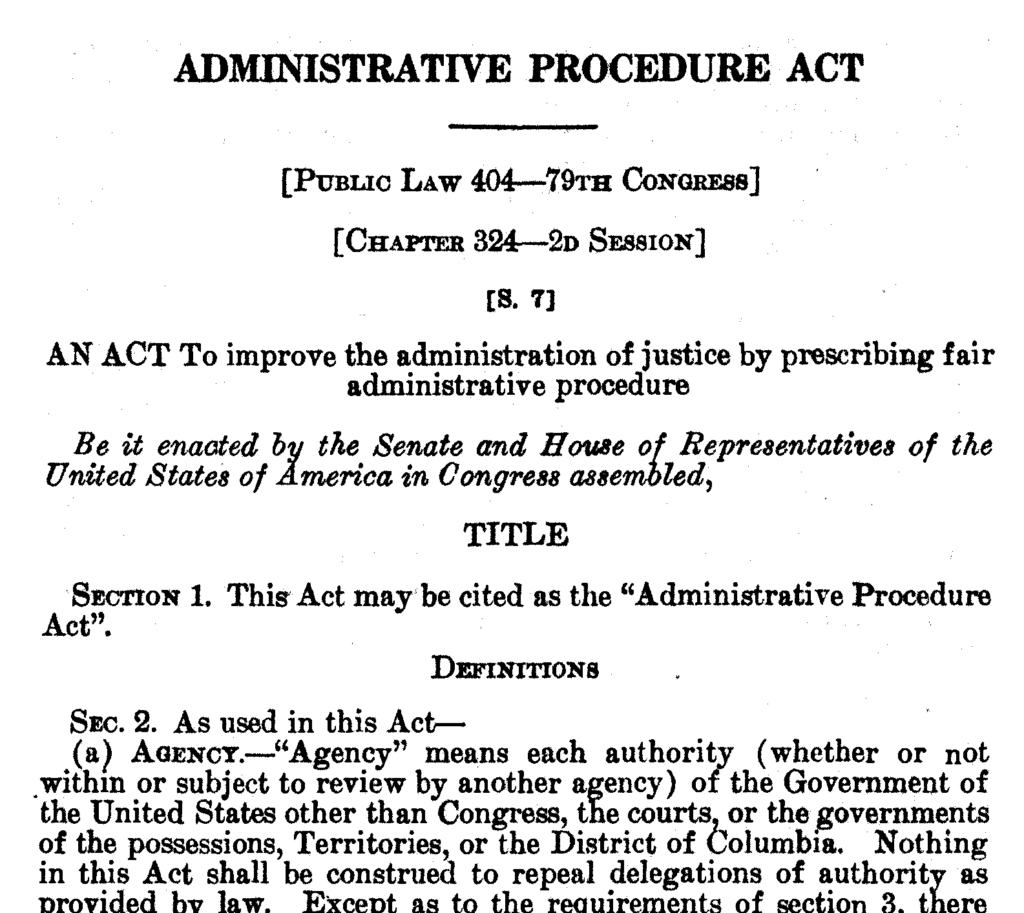
In recent years, some of the Court’s most significant decisions have involved interpretations of foundational administrative statutes. Among these statutes are the Administrative Procedure Act, of course, but also the National Environmental Policy Act, and soon the Federal Reserve Act’s “for cause” removal provision. These procedural statutes have profound impacts on government, jurisprudence, and ultimately on everyday American life.
We can think of this moment as a new era of “APA Originalism.” With the demise of Chevron Deference, there is a new need for scholars, jurists, and practitioners to meaningfully engage with these statutes’ original meanings. Judges may someday be called upon to can rediscover the original meaning of these bedrock laws, and they will face hard questions about legislative history, prior caselaw, and old scholarly work on the birth of administration. While these are not limited to just the APA, the term “APA Originalism”—with a friendly nod to Prof. Ron Levin—seems a good way to describe overall concept.
At the same time, we are also in a new era of what might be called “APA Realism.” Recent decades have seen enormous innovations and tactical shifts within the agencies themselves, in their efforts to comply with (or avoid) the procedures required under the APA and other statutes. At such a moment, it is worth asking whether conventional narratives about the administrative process actually reflect the reality of administrative governance.
Has modern administrative practice deviated from the governing texts? By identifying and studying the contrasts between old narratives and new realities, scholars can help judges better understand current administrative law doctrines—and help legislators identify opportunities for good, bipartisan reforms.
Accordingly, the C. Boyden Gray Center for the Study of the Administrative State is calling for papers on both “APA Originalism” and “APA Realism,” to be presented and discussed at two independent research roundtables at George Mason University, Antonin Scalia Law School in Fall 2026 and Spring 2027 respectively.
As with all of our roundtables, the Gray Center welcomes papers at all stages of development, from very-very-early concept overviews to near-final drafts. If we receive more papers than we can include at these roundtables, then we will select papers with an eye towards diversity of perspective, topic, and stages of development.
To support scholarly research and discussion on this subject, we offer a substantial honorarium for selected drafts, and after the roundtable we will post the author’s subsequent drafts to the Gray Center’s Working Papers Series to help promote academic discourse and legal education..
If you would like to submit a paper for either roundtable, then please email a short description of your project to the Gray Center’s research director, Bennett Nuss (bnuss@gmu.edu) by March 1, 2026. We will schedule the roundtables in consultation with the authors.
