


D.C. Circuit Review – Reviewed: Another Removal Case
Last week, the D.C. Circuit’s motions docket stayed busy with another removal case, this time related to the President’s attempt to remove “for cause” Lisa Cook from her position as a member of the Federal Reserve’s Board of Governors. The district court preliminarily enjoined Cook’s removal after finding that she is likely to succeed on two claims, (1) that she was removed without “cause” in violation of the Federal Reserve Act and (2) that she did not receive sufficient process prior to her removal in violation of the Due Process Clause. The government appealed and sought an emergency stay of the injunction (i.e., a stay that would permit Cook’s immediate removal). The D.C. Circuit denied the stay (over a dissent by Judge Katsas). The majority (Judge Garcia, joined by Judge Childs) hinged its stay denial on agreeing that Cook’s due process claim is likely to succeed. In dissent, Judge Katsas would have held that Cook does not hold a constitutionally protected property interest in her office and that pre-appointment conduct can support “for cause” removal under the Federal Reserve Act. The government has applied for a stay from the Supreme Court; a response to that stay motion is due September 25.
The D.C. Circuit also issued one opinion, which illustrates when an agency action qualifies as an unreviewable exercise of enforcement discretion. In El Puente de Williamsburg, Inc. v. FERC, No. 23-1333, the D.C. Circuit considered environmental groups’ challenge to FERC orders declaring that it would take no action to prevent construction or operation of a new pipeline between a natural gas import facility in Puerto Rico and an emergency generator operated by the Army Corps of Engineers, pending its review of the import facility’s related license applications. As the D.C. Circuit succinctly summed it up:
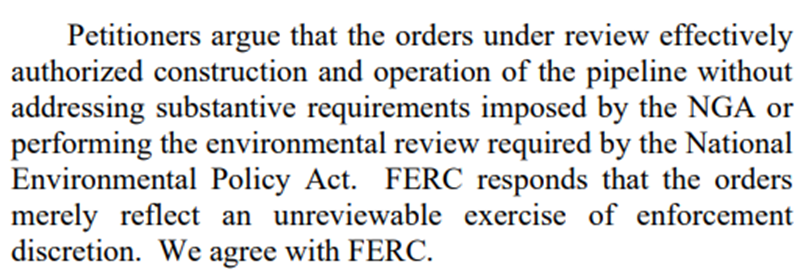
The main factors cited by the D.C. Circuit in classifying the orders as an exercise of non-enforcement discretion were the orders’ language (which did not purport to authorize the pipeline, which remained under review, but indicated that FERC would not seek “to prevent” it through an injunction pending review) and the emergency factors provided as justification (e.g., an impending hurricane season).
