


Introducing a New Methodology for Measuring Judicial Ideology
Scholars, lawmakers, and the public alike express an intense interest in knowing what motivates judicial decision-making. Are judges like umpires, merely calling balls and strikes, as then-Judge John Roberts claimed at his confirmation hearing? Or, are they instead motivated by ideological commitments or other biases?
The dominant view is that judges are driven, at least in part, by ideology. Ideology, in turn, is often framed in terms of partisanship—that is, where a judge falls on a liberal-to-conservative spectrum. Determining whether judges are liberal or conservative, and the strength of their ideological preferences, helps inform our understanding of particular case outcomes. This information can also be used to predict how future cases will be decided. But, because we cannot peer inside a judge’s mind to learn their ideological preferences, researchers commonly infer judicial ideology from behavior that can be observed, including observing the contents of judges’ written opinions.
In a law review article forthcoming in the Indiana Law Journal, I propose a new methodology for measuring judicial ideology. When a judge writes an opinion, information about that judge’s ideological preferences can be inferred from the way that the judge uses, rejects, or ignores tools of statutory interpretation. I propose to measure judicial ideology by examining judicial use of tools of interpretation closely associated with a particular ideological perspective. Because this methodology considers Canons and other Interpretive Tools as they Emerge, I call it the CITE Methodology.
The CITE Methodology relies on observations of judicial treatment of tools of interpretation (like canons of construction) that are 1) closely identified with a partisan political ideology and; 2) that are emerging rather than well-established. First, when judges use a tool that is closely identified with a particular ideology, they signal sympathy with that ideology or membership in the group that claims to adhere to that ideology. Although judges must vote in favor of one or another litigant, judges never are required to rely on interpretive tools to reach their preferred result. Because the use of interpretive tools is voluntary, examining tools associated with partisan ideology is likely to reveal a judge’s ideological preferences.
And second, because ideology increasingly pervades judicial interpretive practices, new interpretive tools come into existence in an environment in which interpretive methodology is highly politicized. As a result, when a judge chooses to adopt or reject an emerging tool of interpretation with a strong ideological valence, the choice can send clear signals about that judge’s ideological preferences.
As proof of concept of the CITE Methodology, I applied the methodology to state supreme court responses to two emerging tools of interpretation closely associated with conservative ideology. Judges on approximately 25% of state supreme courts responded in some way—either positively, negatively, or in a neutral way—to legal corpus linguistics techniques and the major questions doctrine, both of which became associated with the conservative legal movement soon after their recognition by justices of the United States Supreme Court. Applying the CITE Methodology to state supreme court treatment of these emerging tools reveals state court association with the conservative legal movement, and the strength of that association. Below is a figure that shows state supreme court association with the conservative legal movement, as calculated using the CITE Methodology.
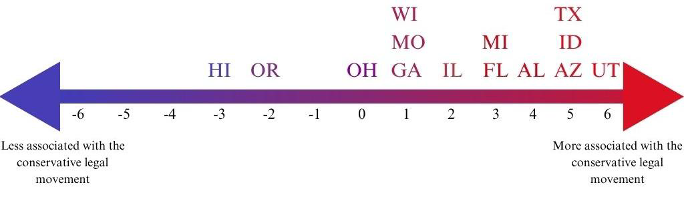
As this figure shows, state courts fall along a spectrum of association with the conservative legal movement. At one end, Hawaii’s supreme court is the state supreme court with the strongest negative association with the conservative legal movement. At the other end of the spectrum, Utah’s supreme court is the state supreme court with the strongest positive association with the conservative legal movement. The other state courts observed fall somewhere between these poles. More state supreme courts were positively associated with the conservative legal movement than were negatively associated with it. The median, mean, and mode of the state courts observed were all positive as well.
The CITE Methodology opens up new possibilities for the study of judicial ideology. Although I have used it with the major questions doctrine and legal corpus linguistics, researchers could use the methodology with other tools of interpretation as they emerge. For example, some courts have expressed interest in using large language models, like ChatGPT, to interpret statutory text. It is possible that this tool of interpretation, as it emerges, will become associated with a particular ideology. If so, researchers could use the CITE Methodology to determine the ideological preferences of courts that use it.
In sum, the CITE Methodology has the potential for contributing to the study of judicial ideology. Researchers can use it on its own to measure judicial ideology. And, they can use it to validate other methodologies for inferring judicial ideological preferences. As a result, the CITE Methodology should be added to the list of tools for researchers studying state court ideology.
Evan C. Zoldan is the Associate Dean for Academic Affairs, John W. Stoepler Professor of Law and Values, and Director of the Legal Institute of the Great Lakes at the University of Toledo College of Law.
