
Void Where Prohibited: The Vacancy at the Heart of Federal Vacancies Law
Surrender, surrender, but don’t give yourself away”
–Cheap Trick (1978)
“I’ve got a blank space baby / And I’ll write your name“
Thomas Berry recently flagged the Federal Vacancies Reform Act‘s front-end problem: eligibility so broad that “more than 350 federal officials [can] fill any vacant office, regardless of qualifications.” That’s a sufficient condition to amend the law, and Berry’s suggestion that “all acting officers, including those from the category of Senate-confirmed officials, must be from the same department or agency as the vacant office they temporarily fill” meets the need.
But there’s a bigger back-end problem. The FVRA’s enforcement mechanism stipulates “an action taken by any person” serving in violation of the law’s requirements “shall have no force or effect” (5 USC § 3348(d)(1)), but affords no actionable remedy for parties who could bear a meaningful cost from those actions. Ordinary APA vacatur asks a court to set aside a thing that is, until then, arguably valid. Under the FVRA the thing didn’t exist in the first place.
“So take a look at me now / Well there’s just an empty space“
A CRS report from April gives a thorough breakdown of the statute’s mechanisms (including the handful of specific exemptions). For our purposes, we can forgo most of the nooks and crannies proscribing limits on the selection of and conditions of eligibility for acting officials if we stipulate generally the law imposes time limits on officials exercising duties in an acting capacity, outside of which the above provision applies. We focus here on those cases where an acting official serves beyond their permitted duration, the particulars of which are immaterial.
Available data on the numerative scope of violations is spotty. GAO is tasked with tracking them, but their work is by no means comprehensive. Their findings of violation are sporadic (and sometimes even land after the offending official left). Nonetheless we do have evidence of fairly recent and significant violations:
- DOJ OLP, Jan.-Mar. 2024 (GAO, Jan. 2025)
- FEMA (GAO, May 2026)
- OIRA, ongoing (Public Employees for Environmental Responsibility, Nov. 2025)
- USDA (GAO, Jul. 2024)
And the larger point is violations, even those otherwise flagrant and obvious, are not systematically identified. GAO’s reports largely depend on the agencies themselves providing notices of appointments, nominations, and official position changes. It’s not a stretch to conclude the total surface area of shadow violations is fairly large.
A 2019 student note in the Harvard Journal on Legislation argues the FVRA doesn’t authorize acting service in a vacancy created by a firing. No court has considered this reading, but if correct, it means some acting appointments never had valid authority full stop. The time elapse between T-minus-invalid-service and dispositive determination thereof could be measured in months (maybe years). That’s not a trivial conundrum.
The articulable boundaries aren’t always obvious. In 2022 in Notice & Comment, Nina Mendelson argued there is jurisprudence that appears to permit Administrations to “bypass the FVRA” in response to questions around the specifics of agency practice. But the broader point stands. The law establishes some finite limits in time and scope thereby establishing there are verifiable conditions of circumstance defining when persons operate beyond them.
“He’s a real nowhere man / Sitting in his nowhere land“
So if someone performs official duties in demonstrable violation anyway, the action is void by operation of law. But it’s operative effect can still be costly.
Imagine a covered regulated party taking notice of a substantive rulemaking overseen by that official. The final rulemaking may even be signed by the official. A clear cut case of an invalid regulation, with no binding effect. But the diligent general counsel for this party, say a large corporation, takes note that yes it shouldn’t be enforceable but the official’s removal is indeterminate. Congress could flex on the Administration, an unwieldy political mechanism on a very specific issue. Not very likely. This could be a legal liability. While the FVRA precludes a compliant successor from immediately ratifying the same thing (Sec. 3348(d)(2)), it does not prevent them from undertaking the requisite steps toward the same policy outcome. In the mean time, an aggressive Administration very well could initiate enforcement actions. Or where a private right of action attaches to noncompliance (like an employee), that’s a whole other headache.
“As your counsel, I have to tell you there’s no great options on what we should do here.”
The CEO, themself an astute attorney, replies: “yes, but this is demonstratively invalid by virtue of an official issuing it in violation of the FVRA. It’s void upon examination. And why did I hire a general counsel, anyway?” The GC, wanting to avoid appearing didactic, subtly indicates to the part of his memo noting the law does not provide a standalone right of action, only as adjunct to another corridor of judicial review.
Like under the APA. The CEO soon recalls on their own this FVRA limitation, but suggests under APA’s Sec. 704 basis of review, that should be sufficient. Yet whereas a credible showing of demonstrable harm for a regulation that is legally disputable presents a clear question of law before the court, a rulemaking auto-voided by virtue of the FVRA is a little more slippery.
Fortunately, Supreme Court precedent provides an express lane to a declaratory judgment – while still not costless – obviating the need for a full on merits ordeal. In theory it should apply to just this kind of situation. At one point this poor GC walks through the “final agency action” test under Bennett v. Spear. An action is final if it:
- marks the “consummation” of the agency’s decision-making process, and
- is one from which “legal consequences will flow.” 520 U.S. 154, 177–78 (1997) (citations omitted).
But what are the legal consequences of a regulatory chimera? A federal evanescence, a Schrödinger’s rulemaking to which there is no invoice billing code? In theory a court doesn’t have to weigh reliance interests or confront unwinding anything under FVRA, because the statute says there was never anything to unwind. Hence NLRB v. SW General, invalidating an unfair labor practice complaint issued by an official ineligible under Sec. 3345(b)(1). But the invalidation is neither self-executing and in this case applied to a tangible regulatory artifact (the labor practice complaint). Our hypothetical CEO/GC interlocutors are facing a shadow regulatory cost, and trying to understand wherein is the relief (or just dispositive clarification). They don’t have an enforcement notice to wave before the court.
NLRB v. SW General, Inc., 580 U.S. 288 (2017), L.M.-M. v. Cuccinelli, No. 1:19-cv-02676 (D.D.C. filed Sept. 6, 2019), and Bullock v. United States Bureau of Land Management, No. 4:20-cv-00062-BMM (D. Mont. Sept. 25, 2020) all provide pertinent recent vintages of courts favorable to pre-enforcement FVRA claims.
And yet, all three still had to proceed to merits, and further in Bullock had a whole secondary question regarding scope after establishing the invalidity condition. None make up a syllabus of reducing transaction costs where obviousness is a precondition.
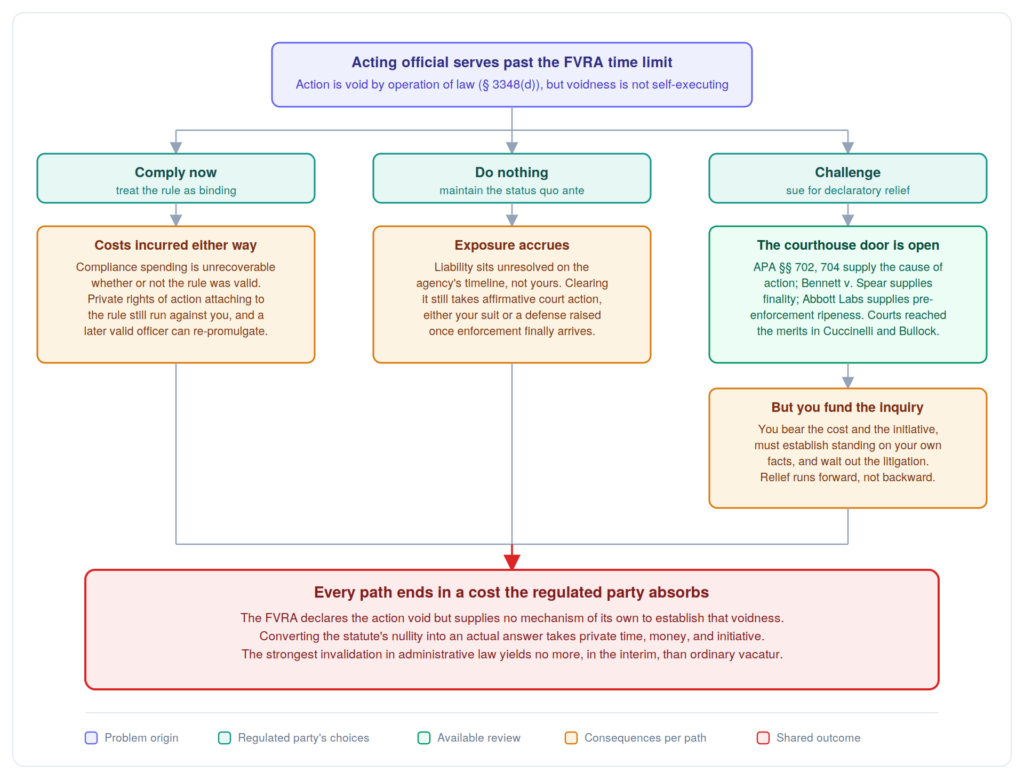
- Comply now: compliance costs are sunk regardless of the validity question eventually, hopefully resolves. There’s no recovery path even when it does.
- Challenge proactively: the suit runs into a finality test. But even a presumptive win is a non-trivial cost. Moreover a thing may appear obvious (the calendar) but establishing dispositively when an official began (and ended) their acting term, coeval nominations and whatnot, in what capacity and duties they were performing – even committees of jurisdiction have trouble sorting this all out.
- Do nothing: the FVRA defect doesn’t disappear. It relocates into whatever enforcement action the agency may eventually bring, where it’s a reactive defense. Legal risk remains.
Fortunately the courthouse door is open. What the firm pays for walking through it is the point, and means a violative administrative action – even an egregious and intentional one – does not in the end amount to “no harm no foul.”
Satya Thallam is an intern at a Bay Area winery He was formerly a senior official at the White House and senior staff in the U.S. Senate, focused on regulatory and institutional process reforms. He previously advised federal policymakers on these topics, including testifying before Congress on administrative law. His general writing can be found at The Grand Resign and in forthcoming literary magazine essays.
