
D.C. Circuit Review – Reviewed: Chevron’s Dead Hand?
Halloween is around the corner, and the time is ripe for a “ghoul” to “sit up in its grave and shuffl[e] abroad.” Is Chevron—lately interred by the Supreme Court—that ghoul?
One can certainly sense its presence in one of the D.C. Circuit’s opinions from last week: CBOE Global Markets v. SEC. The decision (by Judge Garcia, joined by Chief Judge Srinivasan and Judge Millett) denies a petition for review of a Securities and Exchange Commission rule lowering the cap on fees that national securities exchanges may charge investors for accessing their services.
The petitioners argued, among other things, that SEC lacks authority to set a universal access-fee cap. The question was one of statutory interpretation: does SEC’s power to prescribe “rules and regulations” ensuring the “fairness and usefulness of the form and content” of “information with respect to quotations for and transactions in” securities include the authority to set such caps? SEC maintained that it does: fee caps promote the “fairness and usefulness” of “information with respect to quotations” by ensuring that a security’s displayed price closely tracks its true price.
Petitioners considered the “information” provision an oblique way to confer fee-capping authority. They pointed out that Congress included express “fees” powers in other parts of the statute but not here. The Court acknowledges that this cuts against the SEC’s position under the rule that “when Congress includes particular language in one section of a statute but omits it in another section of the same Act, [courts must] generally take the choice to be deliberate.” But several features of the Securities Exchange Act, the court says, weaken the rule’s force.
And that is where Chevron’s ghostly figure appears:
That presumption grows even weaker in statutes where Congress presumably ‘left to reasonable agency discretion questions that it has not directly resolved,’ especially through ‘a broad grant of authority contained within the same statutory scheme.’ Adirondack Med. Ctr. v. Sebelius, 740 F.3d 692, 697 (D.C. Cir. 2014). Congress did just that here. The Act’s provisions, as we have explained, give the SEC broad discretion to regulate the national market system.
Adirondack, the case quoted here, was a classic Chevron decision. It reasoned that, “in an administrative setting,” a canon of construction that infers exclusion from statutory silence cannot overcome Chevron’s “presump[tion]” that Congress empowered agencies to fill gaps in the statute.
In short, the panel rejected petitioners’ argument in part based on a presumption that traces its lineage to Chevron. It is the same presumption that the Court rejected in Loper Bright.
The opinion does not acknowledge this lineage. Reading between the lines, however, its reasoning appears to rest on Loper Bright’s important caveat (as paraphrased in the opinion): “When the best reading of a statute is that it delegates discretionary authority to an agency, [the court’s] role is to ensure the agency has acted within the boundaries of the delegated authority.”
Courts and commentators have puzzled over the caveat’s effect. One could read CBOE Global Markets to stake out a position that Chevron’s presumption from congressional silence reemerges when a statute contains broad grants of authority. That is, the agency will enjoy not only the authority the statute is “best read” to confer, but also the authority on which the statute is silent.
To appreciate the significance of this extension, consider the panel’s other use of Loper Bright’s caveat (in the context of petitioners’ separate argument that the fee cap SEC set was arbitrary and capricious):
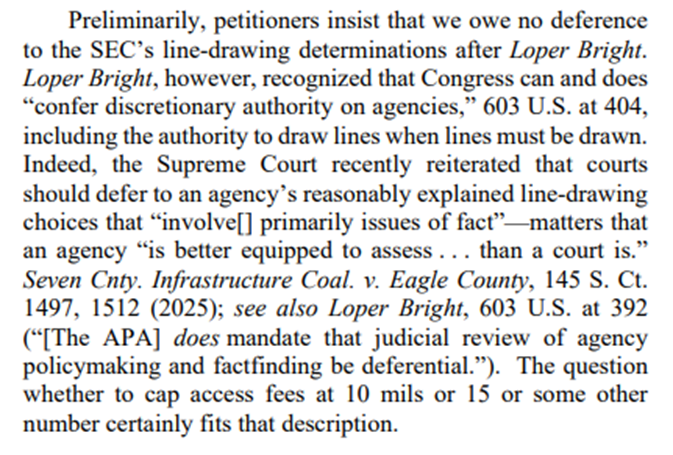
Here, the panel invokes the caveat to defer to SEC’s exercise of the fee-capping power it (by stipulation) possesses. That move is consistent with the Supreme Court’s recent Loper Bright decision: Seven County Infrastructure Coalition v. Eagle County. By contrast, in the passage that cites Adirondack, the panel seems to be using the caveat to defer to SEC’s judgment that it possesses fee-capping authority in the first place. It is doubtful that this sort of deference would be consistent with Loper Bright’s command that courts use “independent judgment . . . to determine the best reading of the statute.”
To be clear, the move may have been of little consequence in this case. The Adirondack citation is one small piece of a broader argument, relying on two additional provisions of the Securities Exchange Act, that SEC enjoys fee-capping authority. But it is interesting because it reveals Chevron’s potential to continue to shape judicial review by way of the D.C. Circuit’s Chevron-era caselaw on how to interpret administrative statutes.
The D.C. Circuit’s other decision from last week reversed the district court’s grant of summary judgment in Campaign for Accountability v. U.S. DOJ. The decision turns on the question whether the Freedom of Information Act requires DOJ’s Office of Legal Counsel to publish certain categories of decisions. To oversimplify, the plaintiff argued that Section 552(a)(2) requires OLC to publish certain categories of opinions in its reading room because they have the “force and effect of law.” The panel (Judge Pan, joined by Chief Judge Srinivasan) rejects this theory. The opinion is lengthy but illuminating on the OLC’s institutional role and the distinction between prospective legal advice (OLC’s function) and retroactive adjudication (an activity that can trigger Section 552(a)(2)’s disclosure obligations).
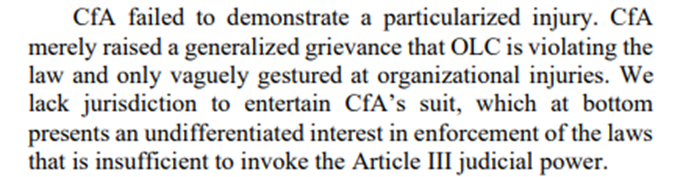
Also notable is Judge Rao’s concurrence in the judgment: she would have dismissed the plaintiff’s complaint for lack of standing. Unlike most FOIA suits—which concern an agency’s failure to respond to a FOIA request by the plaintiff—this suit sought to enforce an agency’s dury to make certain records available to the general public. Thus: