


D.C. Circuit Review – Reviewed: Executive Power Edition
The D.C. Circuit issued seven opinions last week, but most of them were not administrative law cases. They addressed international arbitration (disclosure: I represented amici in support of appellees in that case); constitutional claims related to reincarceration following a mistaken release; fraud claims against federal employees; the False Claims Act; and whistleblower awards for reports of tax fraud. There was one FERC decision falling within the heartland of admin law—it turned on the agency’s failure to consider reasonable alternatives, and is discussed further at the end of this post. But the big news last week involved two decisions about the scope and limits of executive power—or perhaps more aptly, who gets to police those limits and how.
JGG v. Trump, No. 25-5124, involves a dispute about a class of Venezuelan nationals who were removed from the U.S. under the Alien Enemies Act and sent to a prison in El Salvador. The D.C. Circuit had two issues before it.
The first issue was the government’s appeal of the district court’s preliminary injunction requiring the government to facilitate the class’s ability to seek habeas corpus relief (and the government’s related stay motion). Because “the class members have since been released from Salvadoran custody and transferred to Venezuela, where they are not likely to remain in custody,” so “intervening events have overtaken the rationale for the injunction,” the D.C. Circuit (Katsas, Rao, Walker) vacated the injunction in a per curiam order.
A slightly different panel (Pillard, Katsas, Rao) considered the district court’s order in contempt proceedings finding probable cause that some federal officials willfully violated the district court’s earlier temporary restraining order. The TRO had barred the removal of a class of people subject to removal under the Alien Enemies Act per the President’s designation of Tren de Aragua members as alien enemies. After the TRO was entered, the government flew class members to El Salvador and transferred them into the custody of Salvadoran authorities. (The TRO was subsequently vacated by the Supreme Court for lack of jurisdiction because it was issued by D.D.C., which was not the district of confinement). The government maintains that the order barred only removal from U.S. territory, which had already occurred when the TRO entered (i.e., the airplanes were out of U.S. airspace). The class (and the district court) maintained that the TRO barred removal from U.S. custody, which occurred when the class members were transferred to Salvadoran custody after the TRO was entered. The district court offered the government the option of either purging the contempt (e.g., by asserting custody over the transferred individuals) or identifying the names of the officials involved. The order indicated that the officials would be referred for government prosecution or, if the government declined, the court would potentially appoint a prosecutor.
The government appealed the probable cause order and sought a writ of mandamus terminating the criminal contempt proceedings. The panel unanimously agreed to dismiss the appeal for lack of jurisdiction, because there was no jurisdictional basis for an interlocutory appeal. The D.C. Circuit nonetheless granted the writ of mandamus, with Judges Katsas and Rao agreeing to grant mandamus and Judge Pillard dissenting. Each judge wrote a separate opinion.
Judge Katsas reasoned that the contempt proceedings must be terminated because the “the TRO was insufficiently clear to support criminal contempt.” He added that the government’s other arguments “raise difficult questions placing the Executive and Judicial Branches into substantial conflict, which cinches up the case for granting relief now rather than waiting for a final-judgment appeal.” Those arguments were: First, that the “show-cause order unconstitutionally pressures the Executive Branch to engage in sensitive foreign policy negotiations” because the contempt could be purged by reasserting U.S. custody over the individuals (or otherwise facilitating their ability to seek habeas relief). Second, “a court cannot constitutionally appoint a private attorney to prosecute members of the Executive Branch,” which was potentially on the table if the contempt was not purged. And third, “lurk[ing] in the background” but not pressed, was whether “an injunction entered without jurisdiction [can] support criminal contempt.”
Judge Rao concurred on the ground that when “an injunction has been vacated, as occurred here, a district court loses the authority to coerce compliance with the order,” and the district court was impermissibly “us[ing] the threat of [criminal-contempt] punishment as a backdoor to obtain compliance with a vacated and therefore unenforceable TRO,” by offering compliance as a way to purge the contempt and avoid revealing names of responsible officials. In Judge Rao’s view, “Dangling this sword of Damocles to compel the Executive to exercise its foreign affairs powers exceeds the court’s authority and is an abuse of discretion.”
Judge Pillard dissented, beginning her opinion with this:
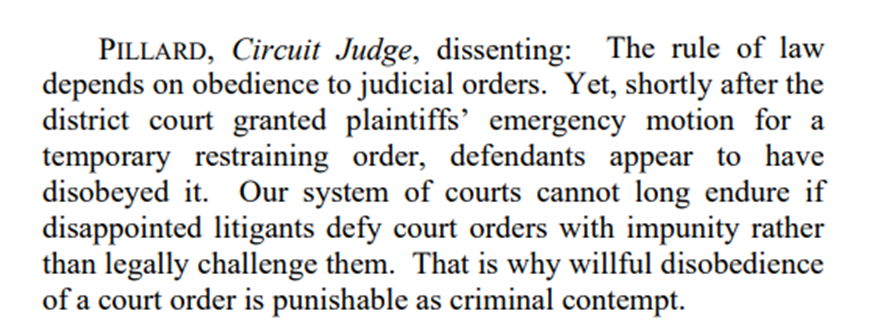
In Judge Pillard’s view, the district court order required the government only to identify the officials who made the relevant decisions, which the government never claimed was privileged. The fact that it gave the government the option of instead remedying the harm to the class did not convert it into a proceeding seeking compliance with a vacated order (Judge Rao’s objection). As for potential ambiguity in the order (Judge Katsas’s objection), Judge Pillard reasoned that the TRO was not ambiguous but even if it were, that was no ground for mandamus because ambiguity “could be fully litigated as an ordinary defense to a contempt prosecution and on appeal from conviction, which makes it ineligible for mandamus.” In addition, any issues about future referral for prosecution could be addressed if that occurred, leaving alternative avenues for relief. Stepping back, Judge Pillard noted that she was unaware of any case finding the requisite clarity for mandamus relief when no member of the panel could agree on what was so indisputably clear.
The Executive Branch did not succeed in the second executive power case of the week, in which the D.C. Circuit ordered the government to restore access to a public database to track the expenditure of congressionally appropriated funds (specifically, apportionment decisions). The database was mandated by statute in 2022. In Citizens for Responsibility and Washington (CREW) v. OMB, No. 25-5266, CREW and another non-profit sued to restore public access to the apportionment information. The administration had ceased posting the information in March, when—”facing multiple lawsuits claiming that it was unlawfully impounding congressional funds”—it determined that “it now deemed the statute unconstitutional and would no longer comply with it.” The district court entered an injunction requiring OMB to keep posting the statutorily required information, among other related relief. The government appealed and sought a stay pending appeal. The D.C. Circuit (Henderson, Wilkins, and Garcia) denied a stay in a per curiam order, accompanied by a statement written by Judge Henderson and joined by Judge Wilkins.
Judge Henderson began her statement highlighting the history behind the Constitution “granting the Congress plenary control over the public fisc”:

In denying the stay, Judge Henderson concluded that “when it comes to appropriations, our Constitution has made plain that congressional power is at its zenith,” affirming Congress’s power to require the disclosures over objections that disclosure interfered with executive functions. The D.C. Circuit also rejected the government’s argument that plaintiffs lacked standing. That part of the statement contains an extensive discussion of the metes and bounds of informational injury, “a class of injury that has been the source of much doctrinal confusion.”
Turning from the high stakes executive power cases to admin law bread and butter, the D.C. Circuit also issued a decision in Louisville Gas & Electric Co. v. FERC, No. 23-1196. The background of the case is this: FERC approved a merger between two utilities, contingent on various mechanisms for ensuring the merged public utility’s customers did not pay duplicate transmission fees (which mechanisms changed over time). In 2019, FERC issued an order eliminating the utility’s obligation to avoid redundant transmission fees, which the D.C. Circuit vacated for failure to conduct an adequate analysis of the public interest. FERC then issued an order coming out the other way, i.e., continuing the utility’s obligation to avoid redundant transmission fees for its customers. The utility then sought review, and the D.C. Circuit again rejected FERC’s order, this time because FERC “failed to adequately consider other potential protections for customers as an alternative to [the utility’s] fee obligation or explain how those protections would be inadequate to protect particular customers.” (The court rejected several other arguments, however, holding that FERC complied with the relevant statutory framework and adequately explained departures from precedent, among other issues.)
