

D.C. Circuit Review—Reviewed: It’s a long [procedural hi]story
The D.C. Circuit issued six administrative-law decisions last week. Several represent the latest installment in protracted legal battles, making for some complicated (or at least long) procedural histories.
Taking the prize for the oldest dispute is Baxley v. Driscoll, which began with Baxley’s “Other than Honorable Conditions” discharge from the Army fifty years ago, in 1976. He has intermittently sought to upgrade his discharge status since that time. Here, he argues that the Army impermissibly considered “exempt evidence” during his discharge proceeding, which under contemporaneous regulations entitled him to a remedy of an honorable discharge. The Court (Judge Wilkins, joined by Judges Henderson and Edwards) reversed the district court’s grant of summary judgment to the Army Board of Correction of Military Records, finding that errors in the Board’s reasoning rendered its decision arbitrary and capricious. Baxley will get another shot at an upgrade under a proper interpretation of the exempt-evidence regulation. Judge Henderson wrote separately to detail the blots on Baxley’s service record that make his prospect of success look bleak.
Next in line is Make the Roadv. Mullin. Thirty years ago, Congress created an expedited removal process for deporting certain aliens. The Secretary of Homeland Security has authority to designate categoriesof immigrants subject to expedited removal, and historically, the Secretary’s designations have reached only aliens apprehended at or near the border. In 2019, President Trump’s Secretary expanded the designation to the statutory boundaries (reaching aliens throughout the country who have been in the country illegally for less than two years). Justice Jackson (then a district judge) preliminarily enjoined the policy. The D.C. Circuit reversed in a fractured opinion Professor Aaron Nielson covered on this blog six years ago. In 2022, President Biden’s Secretary rescinded the designation, and last year, President Trump’s rescinded the rescission. This time, the district court stayed the designation (rather than enjoining it), and an again fractured panel has again reversed. Judge Walker wrote the majority, joined in part by Judge Wilkins and in part by Judge Rao, both of whom write separately to resolve some of the many issues presented by this case differently. The opinions are worth reading. They cover jurisdiction, standing, timeliness, reviewability, and remedial authority, and that’s all before you get to the merits, which include an interesting question about the proper due process standard in the removal context (spoiler: it’s Mullane v. Central Hanover Bank, not Matthews v. Eldridge).
Another regulation dogged by turnovers between Administrations is the National Ambient Air Quality Standard for fine particulate matter. Kentucky v. EPA involves a 2024 rule revising that standard from 12 μg/m3 (set in 2019) to 9 μg/m3. The case began with consolidated petitions for review by industry groups and states, but after the turnover from President Biden to President Trump, the EPA itself moved to vacate the rule, arguing that it was arbitrary, capricious, and in excess of its own statutory authority. This evidently disrupted the Court’s deliberations because more than 18 months have elapsed since the Court hear argument. Ultimately, the Court (Judge Ginsburg, joined by Judges Millett and Childs) rejected the petitions and the Government’s motion in an opinion that carefully examines both the statutory scheme and record.
The Court also decided two pharmaceutical cases. The first, Ardelyx v. Kennedy, further illuminates the interaction between statutes that bar judicial review and arguments that agencies have exceeded their statutory authority. In 2008, Congress directed Health and Human Services to create a system to provide a single, bundled payment for “renal dialysis services,” which is a defined statutory term. It also barred judicial review of “the identification of renal dialysis services included in the bundled payment.” Ardelyx manufactures an oral-only drug that treats a condition that commonly accompanies end-stage renal disease, and in 2024, HHS identified that drug as a “renal dialysis service” subject to bundling. Ardelyx sued, arguing that oral-only drugs in general are not “renal dialysis services,” and that its drug in particular is not one. The district court dismissed for lack of jurisdiction under the provision barring judicial review of “the identification of renal dialysis services.” The Court (Judge Ginsburg, joined by Judges Childs and Pan) affirmed. In doing so, it confirmed that HHS’s determination that the drug isa renal dialysis service in the first place is subject to review (independentreview, under Loper Bright), though the ultimate bundling decision is not. The Court began with the strong presumption of judicial review, which can be over come only by “specific language evincing a congressional intent to preclude judicial review”:
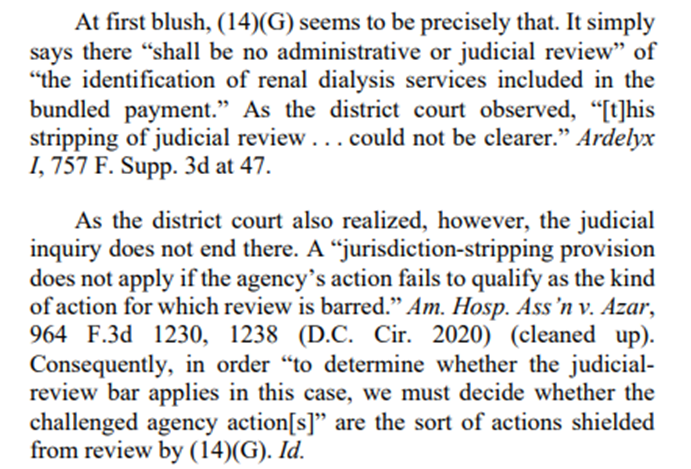
In the end, the Court agreed with the agency that Ardelyx’s drug fits the statutory definition of “renal dialysis services” and affirmed.
The second pharmaceutical case, Norwich Pharmaceuticals v. Kennedy, is more of a civil procedure case than an administrative law case, and for that reason, it’s necessary to get into the convoluted procedural history in some detail. Norwich Pharmaceuticals filed an Abbreviated New Drug Application (ANDA) to market a generic drug that treats two separate conditions. The inventor of the brand-name drug sued for infringement in the U.S. District Court for the District of Delaware. The Court found infringement with respect to one condition but held the patents invalid with respect to the other. It issued a final judgment that prevented the Food and Drug Administration from approving the ANDA until the infringed patents expire in 2029. Norwich sought to amend both its ANDA (to remove labeling related to the condition covered by the valid patent) and the final judgment (to permit FDA to approve the amended ANDA). The district court denied the Rule 60(b) motion, declining to amend its judgment to permit FDA to approve the amended ANDA, and the Federal Circuit affirmed. Consequently, FDA refused to approve the amended ANDA. Norwich sued FDA in DDC, arguing that its refusal was based on a misreading the Delaware judgment—that judgment didn’t speak to the amended ANDA, after all. DDC granted FDA summary judgment. Pointing out that Norwich had argued in its Rule 60(b) motion that the Delaware judgment did bar approval of the amended ANDA, the Court (Judge Walker, joined by Judges Pillard and Garcia) affirmed.
Just as Norwich came to rue its litigating position, so too did HMO Louisiana, the losing party in HMO Louisiana v. HHS. The Centers for Medicare and Medicaid Services publishes “star ratings” for private insurers who participate in the Medicare Advantage program. After HMO Louisiana changed its offerings, it challenged CMS’s calculation of its star rating. CMS agreed to recalculate using HMO Louisiana’s preferred methodology, but the star rating did not change. Now, HMO Louisiana wants CMS to revert to its prior methodology, as other changes to the rating system would produce a higher star rating under the prior methodology. CMS refused, and HMO Louisiana sued, faulting it for (among other things) failing adequately to justify its original change in methodology. The district court granted summary judgment to CMS, and the Court (Judge Pan, joined by Judge Childs) affirmed. Among other things, it held that the change-in-position doctrine does not extend to cases like this one, where the agency does not alter its policy but simply accommodates a regulated party’s request for a change. Judge Henderson concurred in the judgment, without an opinion.
Many thanks to Dan Mohr for his research assistance on this post.
D.C. Circuit Review – Reviewed is designed to help you keep track of the nation’s “second most important court” in just five minutes a week.
