


D.C. Circuit Review—Reviewed: Tucker Act
The Tucker Act has been in the news a lot lately, as a centerpiece of litigation over various Trump Administration grant terminations. The Tucker Act requires parties with contract claims against the government to bring those claims in the Court of Federal Claims. The Court of Federal Claims can award damages, but unlike a federal district court, it cannot order the United States to continue funding the grants, and it cannot offer “preliminary” relief that secures funding streams. The question presented by a series of recent cases is whether lawsuits challenging grant terminations belong in district court or in the Court of Federal Claims.
This past April, the Supreme Court stayed a preliminary injunction against a Department of Education grant termination on the ground that the district court that granted it likely lacked jurisdiction. The grant claims were, in essence, claims to enforce contractual payment obligations and belonged in the Court of Federal Claims under the Tucker Act. Last month, the Supreme Court partially stayed a judgment vacating grant terminations by the National Institutes of Health. Those claims, too, belonged in the Court of Federal Claims.
The same issue arises in Climate United Fund v. Citibank. Or does it? A panel of the D.C. Circuit split on that question last week.
The Environmental Protection Agency made the grants during the Biden Administration, under the Inflation Reduction Act. The grants committed $20 billion to eight nonprofits, which planned to disburse the money to subgrantees investing in various climate-related projects. The Trump Administration first suspended and then terminated the grants, and five of the eight grantees (accounting for $16 billion of the grants) sued. The district court issued a preliminary injunction, which the D.C. Circuit administratively stayed and then vacated last week.
In an opinion by Judge Rao (joined by Judge Katsas), the Court held that Plaintiffs’ claims belonged in the Court of Federal Claims under the Tucker Act, or otherwise lacked merit. Judge Pillard dissented, arguing that the claims were meritorious and belonged in the district court.
The disagreement about the applicability of the Tucker Act stems from the unique structure of EPA’s grant program. Instead of disbursing money out of the treasury over the life of the grant, EPA (under Biden) transferred the entire $20 billion to Citibank accounts in each grantee’s name, from which accounts the grant recipients could draw the funds as needed. Citibank was to act as a financial agent for the United States, and when the United States (now under Trump) directed it to stop disbursing the money, Citibank stopped.
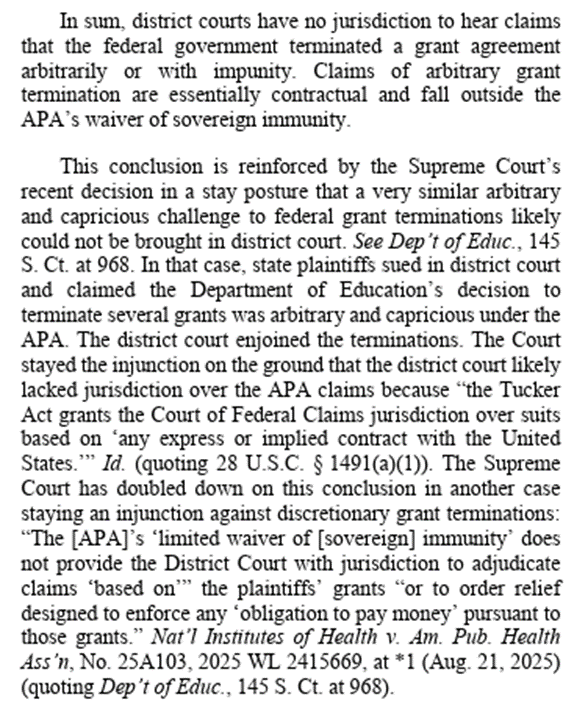
According to the majority, Plaintiffs’ claims are essentially contractual: the United States has allegedly violated the terms of its contract with the grant recipients by directing Citibank to stop disbursing funds. Hence the majority’s characterization of the preliminary injunction: an order to “EPA and Citibank to continue funding the grants.”
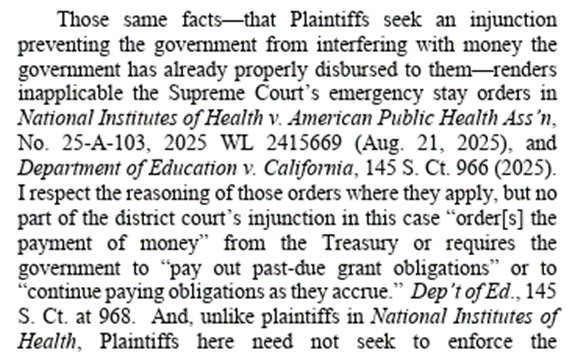
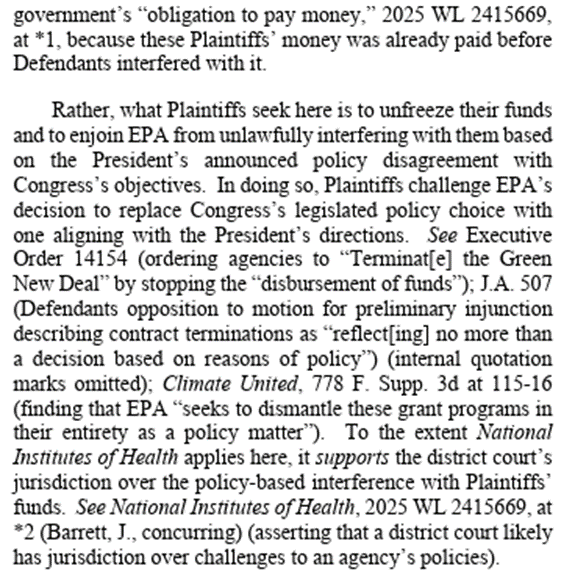
According to Judge Pillard, however Plaintiffs’ claims are claims for unlawful interference with property the grantees already own. Plaintiffs may have entered into a contract with the United States to obtain the funds, but the funds now belong to Plaintiffs, and the United States is arbitrarily, capriciously, and unconstitutionally interfering with it. Hence the dissent’s characterization of the preliminary injunction: an order “to get the government’s hands off [Plaintiffs’] money.”
Here is what the majority has to say about the connection to the Supreme Court’s recent grant decisions:
And here is Judge Pillard:
Leaving aside the jurisdictional issues, the case relates to a problem we have previously discussed on this blog: the administrative dynamics of changes in presidential administrations. The majority details the measures that the outgoing administration took to protect its grants from changing policy priorities, including last-minute changes to the contract terms to make it more difficult for the United States to terminate the grants. Judge Pillard—who has much to say about “the integrity and virtue of the previous administration’s efforts to implement the Inflation Reduction Act”—details measures that the incoming administration took to freeze and then reverse the prior administration’s commitments. These sorts of thrusts and parries have been going on since at least the Midnight Judge appointments in the Adams Administration, and they take an interesting, and (allegedly) troubling form here.
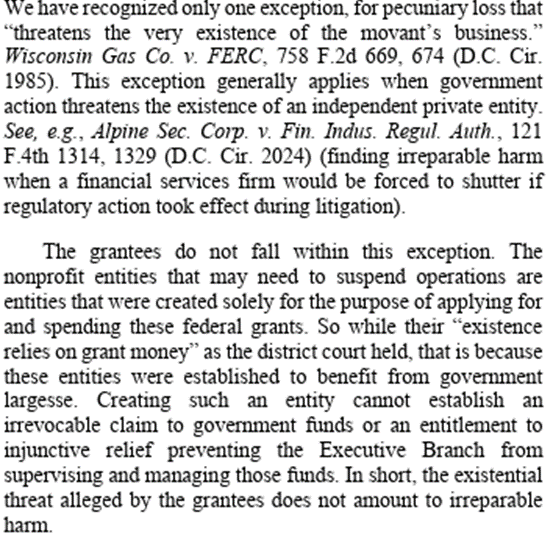
Both opinions also vividly describe the injuries and the equities at stake in grant fights. On the one hand, even if the grant recipients get their money (either in the form of performance or damages), projects may be difficult to get up and running again after protracted litigation. On the other hand, the United States is unlikely to recover grant funds after it disburses them, which puts new administrators concerned about grant legality or oversight in a difficult position. The majority concluded that the Government’s interest in “properly and prudently managing billions of dollars in public funds” outweighed the grantee’s interest in continued access to those funds. And it concluded that the injury the grant recipients would suffer from losing access to the funds did not justify interim relief because pecuniary loss almost never constitutes “irreparable injury”:
The D.C. Circuit had two other administrative law decisions last week. (A third involved an agency party—the Washington Metropolitan Area Transit Authority—but the issue on appeal is the interpretation of a settlement agreement. And a fourth involved an executive officer party—the Secretary of the Navy—but it was a habeas case.)
Judge Rao, joined this time by Judges Walker and Ginsburg, also had the opinion in SSM Litigation Group v. EPA. That decision granted a petition to review an EPA rule that rescinded an affirmative defense for operators of stationary sources of air pollution that exceed emission limitations during emergencies. EPA believed that the affirmative defense violated the Clean Air Act’s requirement that emissions standards be “continuous.” The Court rejected this justification: “An affirmative defense allows a defendant to avoid liability, but it does not alter the underlying legal requirements.” It reversed the rescission. In Compania Cervecera de Puerto Rico v. NLRB, the Court denied a petition to review (and granted a petition to enforce) an National Labor Relations Board order determining that a brewing and bottling company had engaged in unfair labor practices. Judge Childs, joined by Judge Rogers, held that the opinion was supported by substantial evidence. This time, Judge Rao was in dissent. One point of disagreement: the proper standard for identifying a collective bargaining impasse.
D.C. Circuit Review – Reviewed is designed to help you keep track of the nation’s “second most important court” in just five minutes a week.
